
A stock you’ve been watching just fell 35% in a month. Your first thought: it’s on sale, time to buy. But a lower price tag doesn’t always mean a better deal. Sometimes a falling stock is a genuine bargain. Sometimes it’s a warning you’re about to ignore.
This is especially important when looking for stock recommendations for short term, where price movements can be driven by momentum, sentiment, earnings surprises, or changing market conditions. A sharp fall may create an opportunity, but only if the underlying business and technical setup support a recovery.
The “It’s Cheaper Now” Trap
When a stock falls from ₹1,000 to ₹650, it’s natural to compare it to that old ₹1,000 price and think it’s now 35% off. But that old price was never guaranteed to be the “right” price either. Comparing a stock only to its own recent history, instead of to what the business is actually worth today, is a trap called anchoring.
A stock isn’t cheap just because it used to be more expensive. It’s cheap only if the price has fallen further than the company’s real problems actually justify.
Two Reasons a Stock Falls
A temporary overreaction. The market panics over short-term news, a weak quarter, or a sector-wide scare that doesn’t change the company’s long-term earning power. Once the panic fades, the price often recovers.
A real, ongoing problem. The business itself is deteriorating: falling sales, rising debt, a shrinking market share, or an industry that’s permanently changing. In this case, the stock isn’t randomly cheap, it’s pricing in a genuinely weaker future. Buying here is often called catching a falling knife, because the price can keep cutting lower for a long time.
How to Tell the Difference
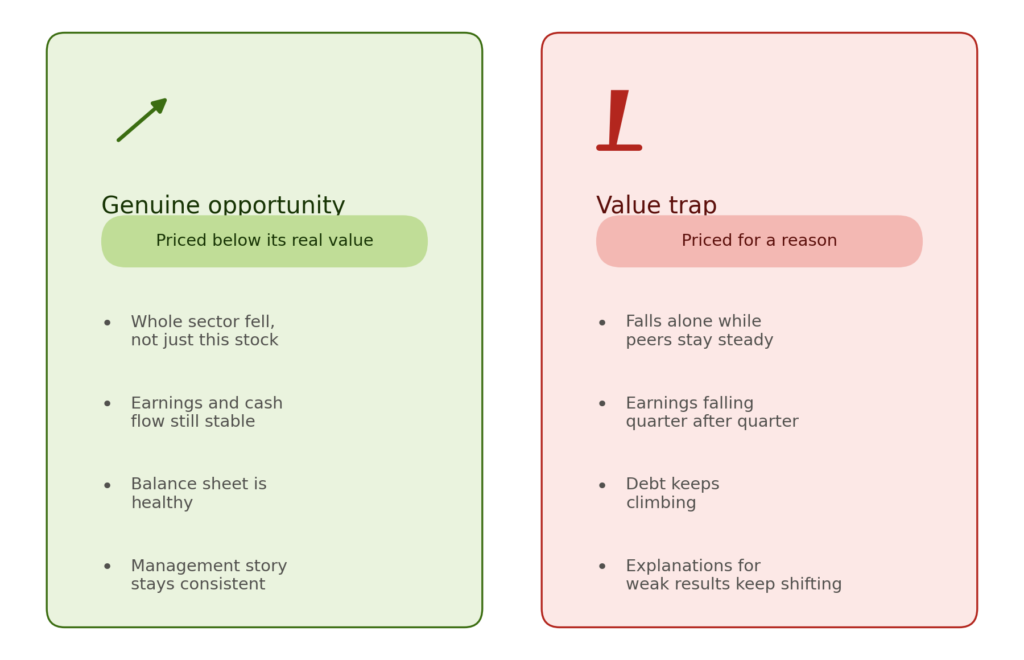
- Check whether the whole sector fell together, or just this one stock. A sector-wide dip is often temporary sentiment. A single stock crashing while its peers stay steady is a bigger red flag.
- Look at earnings, not just the price. If profits and cash flow are holding up, the drop may be sentiment driven. If earnings are shrinking too, the price may simply be catching up to reality.
- Check debt levels. A company drowning in debt has far less room to recover from a rough patch than one with a clean balance sheet.
- Read what management is actually saying. Vague reassurances and shifting explanations for weak results are worth noticing.
- Ask why competitors aren’t falling as hard. If rivals in the same industry are steady, the problem may be specific to this company, not the sector.
Two Stocks, Two Very Different Falls
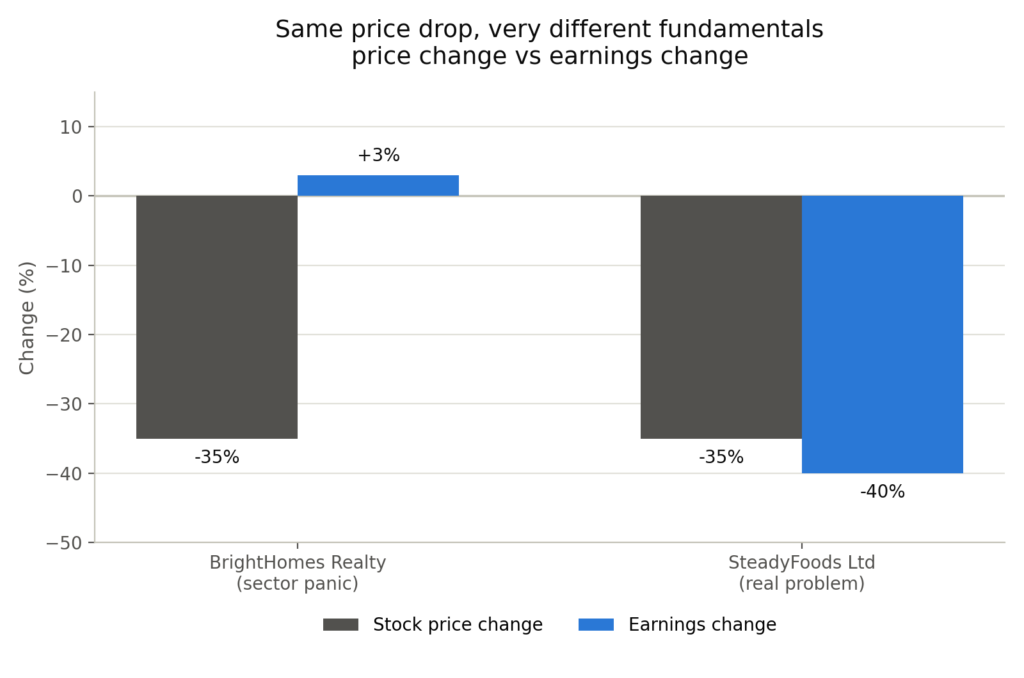
Let’s imagine two companies whose stocks both fall 35% in the same month.
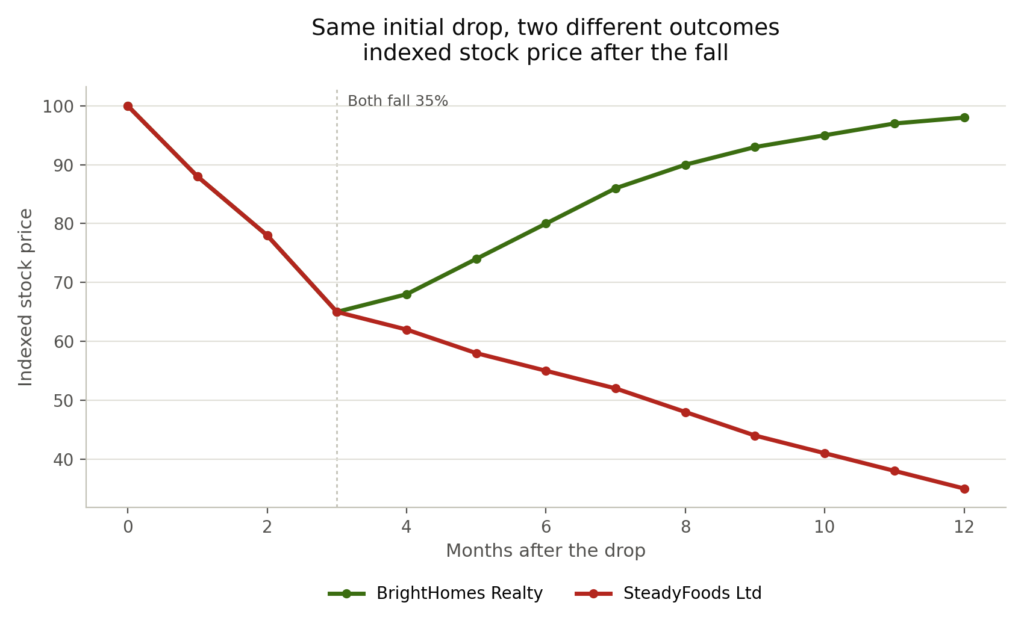
BrightHomes Realty drops after a broad, sector-wide sell-off hits every real estate stock on the exchange, triggered by a single interest rate scare. Its bookings, cash flow, and project pipeline haven’t actually changed. Within six months, the stock has recovered most of its losses.
SteadyFoods Ltd falls the same 35%, but for a different reason. A key product line is losing market share to competitors, debt has been climbing for two years, and profit margins have been shrinking every quarter. A year later, the stock is down even further.
| Signal | BrightHomes Realty | SteadyFoods Ltd |
|---|---|---|
| Why the price fell | Sector-wide panic over rates | Market share loss, rising debt |
| Earnings trend | Stable | Falling for several quarters |
| Rest of the sector | Fell together | Peers held steady |
| What happened next | Recovered within months | Kept falling over the next year |
What to Check Before You Buy the Dip
- Don’t buy just because a stock is far below its old high. That high may never have been justified in the first place.
- Separate the stock price from the business. Ask what has actually changed at the company, not just on the chart.
- Give yourself time. A company with real, ongoing problems usually keeps showing more warning signs the longer you watch it.
- Remember that a falling stock can keep falling. There’s no rule saying a 35% drop can’t become a 60% drop.
Understanding short term trading strategies can help investors avoid blindly buying a falling stock. A disciplined swing-trading approach focuses on identifying strong setups, managing risk, and using clear entry and exit levels.
Conclusion
Traders have a phrase for buying a stock purely because it’s fallen a lot: catching a falling knife. Grab it at the wrong moment, and it doesn’t matter how good a deal the price looked like. You still get cut.
A falling stock isn’t automatically a bargain, and it isn’t automatically a warning either. It’s a question. The only way to answer it honestly is to look past the price tag and check what’s actually happening inside the business.