

The martingale idea is straightforward: every time the price drops to a planned level, the investor buys more units, usually increasing the quantity as the price falls. Because each new buy happens at a lower price, the overall average buying price comes down sharply. If the instrument later returns near its old level, the investor earns a good profit even if the market only recovers to where it started or slightly below.
Why Down Markets Can Be an Opportunity
In broad equity indices like Nifty 50, history shows that big crashes happen from time to time, but over the long run the index trend is upward. Falls of 20–45 percent have happened around major events such as financial crises, demonetisation, or the Covid shock, yet the index has eventually made new highs each time. For a long-term investor with steady income, these deep corrections are not only scary phases but also rare chances to buy quality exposure at much lower prices.
Choosing the Right Instruments
Martingale is extremely dangerous on single stocks because some companies never come back, or even go to zero. Examples like failed airlines or collapsed financial companies show that blindly averaging a weak stock can destroy capital permanently. Instead, the strategy is better suited to instruments that move with the whole market and have a natural long-term upward drift, such as:
- Index ETFs (for example, a Nifty ETF like Nifty BeES).
- Broad, diversified mutual funds (for example, a flexi-cap fund that closely tracks market cycles).
These instruments are backed by many underlying companies and are regularly rebalanced, so the chance of permanent zero is far lower than in a single stock.
How the Buying Ladder Works
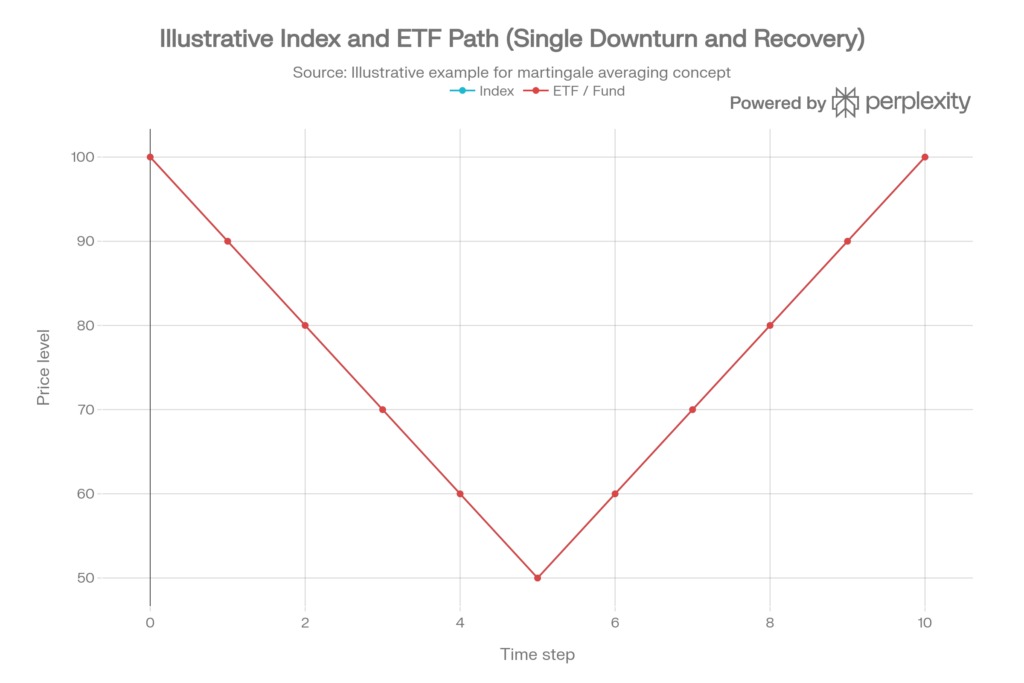
Consider a simple price path where an index proxy starts at 100, falls step by step to 50, and then slowly climbs back to 100, while a matching ETF or fund tracks it closely.
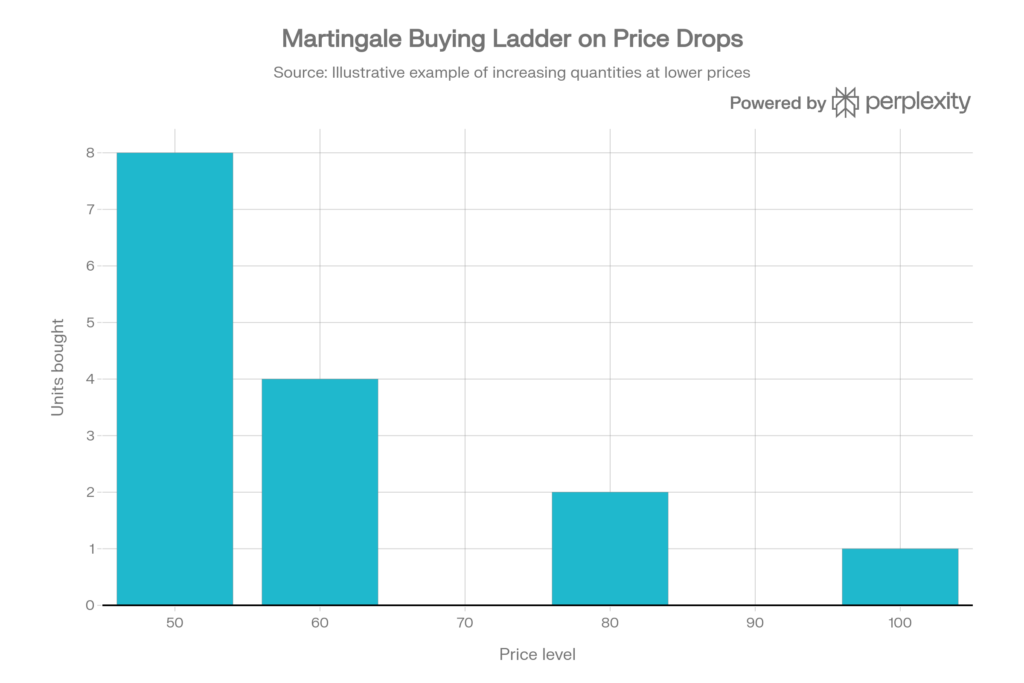
On this path, a martingale investor might plan a ladder like this:
- At 100: buy 1 unit.
- At 80: buy 2 units.
- At 60: buy 4 units.
- At 50: buy 8 units.
In this example, the total cash invested is 900 and the total quantity is 15 units, giving an average cost of 60 per unit. When the price later returns to 80, 90, or 100, the profit on 15 units above 60 can be significant even though the index only went back to its old level.
Step-by-Step Plan to Use Martingale in a Down Market
A simple, practical plan for a long-term investor with steady cash flow might look like this:
- Define your core instrument. Choose one or two broad instruments that mirror the market, such as a Nifty ETF or a diversified mutual fund.
- Study past drawdowns. Look at how much the index and the chosen fund fell in earlier crises (for example 20, 30, or 45 percent) and how long it took to make new highs.
- Create a buying ladder. Decide in advance at what percentage falls you will buy and how much. For example, buy small at 10 percent down, double at 20 percent down, and add more at 30 percent down.
- Allocate capital logically. Work backward from your total capital so that even if the market falls as much as the worst past drawdown, you still have money left for the lowest rungs of the ladder.
- Set a review and exit rule. Decide beforehand whether you will trim or stop buying once the price has moved a set distance above your average cost or near previous highs.
Mental Game and Cash-Flow Requirements
The martingale strategy needs two things more than anything else: confidence that the instrument will eventually recover, and real cash flow to keep buying during the fall. Without fresh money, the ladder breaks in the middle, and the whole logic of reducing the average buying price fails. That is why this approach is better for people who earn steady salaries, run stable businesses, or otherwise generate regular surplus cash that can be invested over many years.
It also needs emotional discipline. An investor who checks the portfolio every hour and panics at every red number will struggle to keep averaging down. Accepting that temporary drawdowns are normal in equity investing, and focusing on the long-term trend of the index, makes it easier to stay with the plan.
Big Risks You Must Respect
Even with index-based instruments, martingale is not a magic or risk-free strategy.
The first major risk is trend change: if a country or market enters a very long stagnation or decline, the recovery may take much longer than expected, or may not fully happen in real terms.
The second is capital exhaustion: if the market falls beyond past extremes or faster than planned, the investor may run out of cash before the planned ladder is complete.
A third risk is instrument mismatch. Choosing a fund that quietly underperforms the index, charges very high fees, or takes concentrated bets can weaken the link between the index recovery and the investor’s actual returns. For these reasons, martingale should be used thoughtfully, in moderation, and only with money that is truly long-term.
Because strategies like Martingale involve increasing exposure during market declines, investors should ideally plan such approaches with the guidance of a SEBI registered investment advisor who understands portfolio risk, capital limits, and long-term market cycles.
When Martingale Can Be the “Best” Strategy
Martingale is powerful in a very specific context: a broad market with a long-term upward bias, a deep but temporary fall, and an investor who has both cash flow and patience. In such a setting, aggressively averaging down in a planned way can turn scary crashes into the most profitable phases of a multi-decade investing journey.
However, there is no single best strategy for every person or every market. Martingale should be seen as a structured way to do what many investors try to do emotionally—buy more when prices are low—but with clear rules and careful choice of instruments. Used on broad, resilient indices and their funds, it can be one of the most effective tools for building long-term wealth in down markets.
When Martingale Can Be the “Best” Strategy
Martingale is powerful in a very specific context: a broad market with a long-term upward bias, a deep but temporary fall, and an investor who has both cash flow and patience. In such a setting, aggressively averaging down in a planned way can turn scary crashes into the most profitable phases of a multi-decade investing journey.
However, there is no single best strategy for every person or every market. Martingale should be seen as a structured way to do what many investors try to do emotionally—buy more when prices are low—but with clear rules and careful choice of instruments. Used on broad, resilient indices and their funds, it can be one of the most effective tools for building long-term wealth in down markets.
For the best short term stock trading advice in India, consider joining our premium service for professional market guidance.