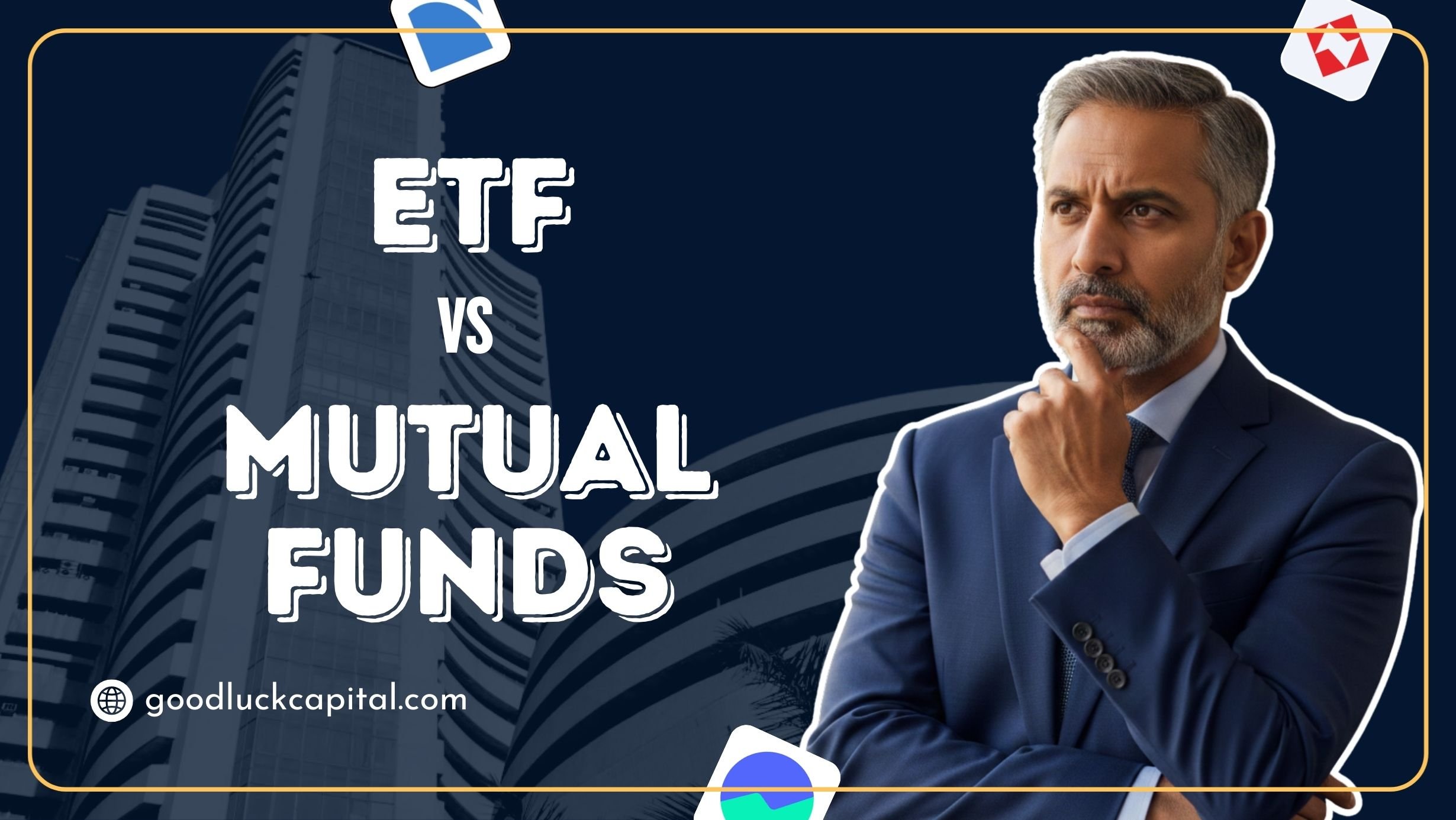
You want to invest your money wisely. You’ve heard about mutual funds and ETFs (Exchange-Traded Funds). Both promise to grow your wealth. Both are popular in India. But which one should you pick?
If this question keeps you up at night, relax—you’re not alone. Even experienced investors debate this. Let’s break it down together.
What’s the Difference?
Mutual Funds: The Hands-Off Approach
Think of a mutual fund as hiring a professional money manager. You give him your money (say, ₹1,000), and he pools it with thousands of other investors’ money. Then, he actively picks stocks and bonds for you—buying and selling regularly to beat the market.
How it works:
- You call your fund house or use an app
- You place an order anytime during the day
- At day-end, your transaction happens at the Net Asset Value (NAV)—a fixed price
- The fund manager works the rest
Real example: Axis Bluechip Fund actively picks large-cap stocks. The manager reviews companies quarterly and makes decisions to outperform the market.
ETFs: The Index-Following Approach
ETFs are like buying a ready-made recipe instead of cooking from scratch. They passively track a market index (like Nifty 50 or Sensex), doing exactly what the index does—nothing more, nothing less.
How it works:
- ETFs trade on stock exchanges (NSE/BSE) like regular shares
- You buy/sell them during market hours at live prices
- You need a Demat account (like a bank account for shares)
- No active manager making decisions—just mirroring the index
Real example: Nifty 50 ETF holds the same 50 companies as the Nifty index. When Nifty changes, the ETF changes automatically.
Most SEBI registered stock advisory firms now recommend ETFs as core portfolio holdings due to their low cost and transparency.
Head-to-Head Comparison
| Feature | Mutual Funds | ETFs | Winner |
|---|---|---|---|
| Who manages it? | Active manager picking stocks | Computer tracking index | Depends on your preference |
| Buying/Selling | Once per day at NAV | Anytime during market hours | ETFs (more flexible) |
| Cost (Expense Ratio) | 1.5–2.25% annually | 0.05–0.75% annually | ETFs (much cheaper) |
| Minimum investment | ₹500 (often via SIP) | 1 unit (varies by price) | Tied |
| Need Demat account? | No | Yes | Mutual Funds (easier) |
| Transparency | Monthly disclosures | Daily holdings visible | ETFs (more transparent) |
| Tax efficiency | Moderate | High | ETFs |
| Best for | Long-term SIP investors | Cost-aware, active traders | Depends on you |
The Cost Factor: Why It Matters
Here’s where ETFs shine. Let’s do the math.
Scenario: You invest ₹10 lakhs for 15 years at 12% annual growth.
- Mutual Fund (2% expense ratio): Net return ≈ 9.8% → Grow to ₹58 lakhs
- ETF (0.5% expense ratio): Net return ≈ 11.5% → Grow to ₹65 lakhs
Difference: ₹7 lakhs extra from ETFs!
Why? That tiny 1.5% cost difference compounds over years. You don’t “feel” it today, but 15 years later, it’s massive.
However, ETFs have trading costs:
- Brokerage fees when you buy/sell
- Bid-ask spreads (small price differences)
For long-term buy-and-hold investors, these are negligible. For active traders, they add up.
Which Is More Transparent?
ETFs win clearly here.
- ETF holdings: Published daily. You can see every stock, every weight, every price—real-time.
- Mutual Fund holdings: Disclosed monthly. You have to trust the manager’s decisions between reports.
If you’re the type who loves tracking investments, ETFs give you peace of mind. If you prefer “set and forget,” mutual funds work fine.
Tax Implications
Good news: Both are taxed almost identically in India.
| Type | Holding Period | Tax Rate |
|---|---|---|
| Equity ETF/MF | Less than 1 year | 15% |
| Equity ETF/MF | More than 1 year | 10% (on gains above ₹1 lakh) |
| Debt ETF/MF | Less than 3 years | Your income tax slab rate |
| Debt ETF/MF | More than 3 years | 20% (with indexation) |
The only difference: ETFs are slightly more tax-efficient because they have lower turnover (the fund manager doesn’t buy/sell constantly). This means fewer capital gains distributions hitting your tax bill.
Performance: Who Wins?
Here’s the honest truth:
Over long periods (10+ years), ETFs typically outperform average mutual funds.
Why? Because they have lower costs. Costs are the biggest drag on returns.
But here’s the catch: Some top mutual funds DO beat ETFs. Funds like Parag Parikh Flexi Cap and Axis Bluechip have consistently outperformed. These are exceptions, not rules.
2024-2025 Trend: In India, passive investing is booming. SEBI is promoting low-cost products. ETF trading volumes jumped 7 times in five years—from ₹51,101 crore to ₹3.83 lakh crore. This shows investor confidence.
Liquidity: When You Need Money Fast
ETFs: Trade like stocks. Sell anytime during market hours. Get cash within 1–2 days.
Mutual Funds: Redeem anytime, but money comes at day-end NAV. Gets credited to your bank within 1–3 working days.
For most long-term investors, this difference doesn’t matter. For traders or those needing urgent access, ETFs are superior.
Here’s Who Should Choose What
Choose Mutual Funds If:
✅ You’re a beginner comfortable without a Demat account
✅ You prefer automatic SIPs (Systematic Investment Plans)
✅ You want a manager actively managing your money
✅ You’re investing for long-term goals (retirement, education)
✅ You like “set and forget” investing
✅ You believe some managers can beat the market
Choose ETFs If:
✅ You understand the market and want low costs
✅ You’re okay with a Demat account
✅ You prefer transparency and real-time pricing
✅ You like trading flexibility
✅ You’re a young investor with time on your side
✅ You believe in index investing (buy-and-hold)
How to Invest ₹10,000 per Month: A Realistic SIP Portfolio
| Category | Instrument | Monthly SIP | Why |
|---|---|---|---|
| Core | Nifty 50 ETF | ₹ 3,000 | Low-cost, broad market exposure |
| Diversification | Axis Midcap Fund | ₹ 2,000 | Active management for higher growth |
| Stability | Bharat Bond ETF (2033) | ₹ 2,000 | Predictable returns, lower volatility |
| Growth | Parag Parikh Flexi Cap | ₹ 1,500 | Quality stocks + global exposure |
| Hedge | HDFC Gold ETF | ₹ 1,500 | Protection during market stress |
This mix gives you:
- Low costs (from ETFs)
- Professional management (from active funds)
- Diversification across asset classes
- Flexibility and transparency
Final Verdict: It’s Not Either-Or
Here’s the secret nobody tells you: You don’t have to choose just one.
The smartest investors use both:
- ETFs for core holdings (Nifty 50 ETF, Gold ETF, Bond ETF)
- Mutual Funds for thematic growth (mid-cap, small-cap, sector-specific)
This balance gives you low costs + professional management + flexibility + diversification.
Conclusion
In the words of investment wisdom: “The best investment is the one that keeps you invested.”
Whether you choose mutual funds, ETFs, or a blend of both, what matters most is starting today and staying the course for 15+ years. That’s how ordinary Indians become wealthy.
Your future self will thank you for every rupee you invest today.
Want to invest in the stock market? Check out our Expert share market tips for smart, research-backed investment guidance.