
In an IPO, investors are put into different “buckets” mainly based on how much money they invest and who they are (normal person, big fund, company, etc.). These buckets decide how many shares each group can get and how shares are distributed when the IPO gets a lot of applications.
Imagine an IPO Like a Big Cake
Think of an IPO as a big cake a company is selling for the first time.
There are three kinds of guests:
- Normal guests (small investors)
- Rich guests (HNIs and other big individuals/companies)
- VIP guests (big institutions like mutual funds and banks)
The rule-maker SEBI says, “This much cake is only for normal guests, this much for rich guests, and this much for VIPs,” so that one group cannot eat everything.
What is an IPO
IPO (Initial Public Offering) is when a private company sells its shares to the public for the first time and becomes a listed company on the stock exchange.
Anyone who applies for these new shares during the IPO period is called an IPO investor.
Why Investors Are Divided Into Categories
If there were no types, very rich and very big investors could buy almost all the shares, leaving very little for common people.
So SEBI has made clear categories and has reserved a fixed percentage (quota) of shares for each type to keep things fair and transparent.
This is one reason why many investors prefer guidance from a SEBI registered trading advisory in India, especially when evaluating IPO opportunities.
The Main Types Of IPO Investors
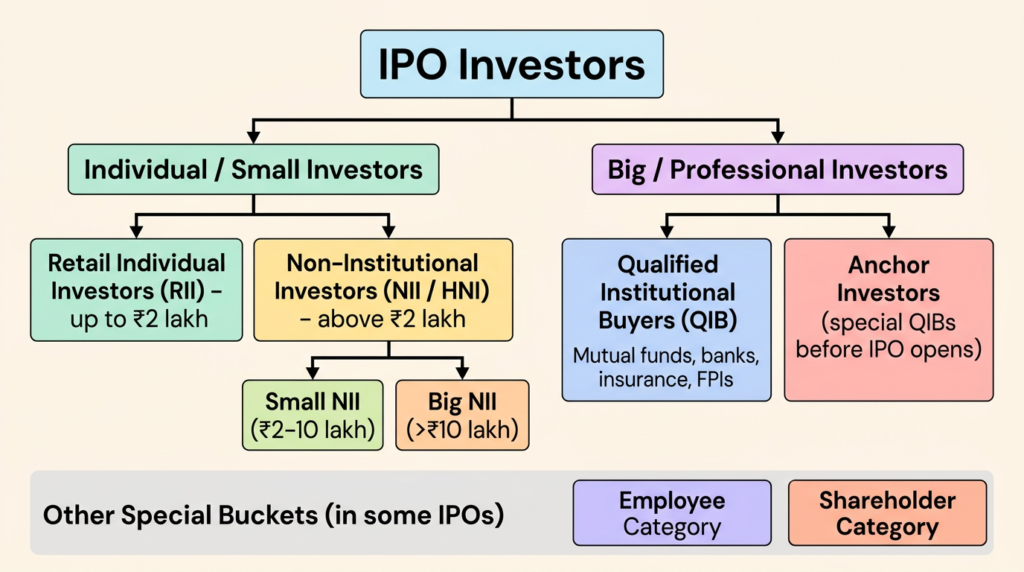
In Indian mainboard IPOs, you will usually see these main categories:
- Retail Individual Investors (RII) – normal people investing small amounts
- Non‑Institutional Investors (NII) / High Net‑worth Individuals (HNI) – rich individuals, companies, trusts, etc. investing big amounts
- Qualified Institutional Buyers (QIB) – big professional institutions like mutual funds and banks
- Anchor Investors – special QIBs who come in just before the IPO opens
- Employees and existing shareholders – sometimes get a small reserved portion
Let’s go through each in very simple language.
Retail Individual Investors (RII)
Retail Individual Investors are people (including NRIs and HUFs) who apply for shares worth up to ₹2 lakh in that IPO.
Key points about RIIs:
- Investment limit: Up to ₹2,00,000 in one IPO.
- Quota: Usually at least 35% of the IPO is reserved for retail investors in profitable companies. For some loss‑making companies, this retail quota can be as low as 10%.
- Cut‑off price option: Retail investors are allowed to apply at the cut‑off price, which simply means, “Whatever final price the company decides, I’m okay with that.” This increases their chance of getting shares.
- Allotment style: When the retail portion is oversubscribed, shares are generally allotted by a computerized lottery so that even very small applications get a fair chance.
In very simple words:
Retail = common people, small money, special protection and fair‑chance lottery.
For beginners exploring IPOs or even positional stock tips in India, the retail category is often the most relevant entry point.
Non‑Institutional Investors / HNIs (NII)
Non‑Institutional Investors are bigger players who apply for more than ₹2 lakh in one IPO.
They can be rich individuals, companies, trusts, or other bodies that are not registered as QIBs.
Key points about NIIs:
- Investment limit: More than ₹2,00,000 in that IPO.
- Quota: Usually 15% of the IPO is reserved for NIIs.
- Sub‑types:
- Small NII (sNII): Between ₹2 lakh and ₹10 lakh.
- Big NII (bNII): Above ₹10 lakh.
SEBI has split them like this so that even medium‑sized rich investors are not pushed out by ultra‑rich ones.
- Allotment style: If the NII portion is oversubscribed, shares are given proportionately – if the category is subscribed 10 times, you roughly get 1/10th of what you applied for.
In simple words:
NII/HNI = rich people and entities, bigger cheques, smaller quota than QIBs, but allotment based on size of the application.
Qualified Institutional Buyers (QIB)
QIBs are the “VIP guests” of the IPO world.
These are big, professional, and heavily regulated institutions like mutual funds, commercial banks, insurance companies, and registered foreign portfolio investors.
Key points about QIBs:
- Who they are: Mutual funds, banks, insurance companies, public financial institutions, FPIs registered with SEBI, and similar big institutions.
- Quota: Broadly, around half of the issue size can be reserved for QIBs in normal mainboard IPOs; regulations cap their share at not more than 50% in many cases, though in some specific structures their share can go higher.
- Why they matter: When strong QIBs apply heavily, many investors take it as a “quality signal” that big experts like the company’s story.
In simple words:
QIB = expert institutions with huge money, large quota, whose interest often boosts market confidence.
Anchor Investors
Anchor investors are a special sub‑set of QIBs.
They are big institutional investors who agree to buy a chunk of shares just before the IPO opens for everyone else.
Key points about anchors:
- They are usually large QIBs who put in a big amount (often in crores) one day before the IPO opens to the public.
- Their shares are locked in for a period (often 30–90 days), so they cannot quickly sell on listing day.
- Their early participation gives comfort to other investors: “If these smart, big players are coming in, maybe this IPO is worth looking at.”
In simple words:
Anchor = early VIPs who come before others and help build trust in the IPO.
Employees And Shareholders
Some IPOs also keep a small piece of the cake for:
- Employees – people working in the company may get a reserved portion and sometimes a small discount on the IPO price.
- Existing shareholders – for example, shareholders of the parent company might get a separate quota called “shareholder category.”
This is like the company saying “thank you” to those who helped it grow or already trusted it earlier.
Bottom Line
IIPO categories are made to keep things fair for everyone.
Retail investors (small investors) get a fair chance through a lottery system. NIIs (big investors) get shares based on how much they apply for. QIBs (large institutions) bring big money and trust to the IPO. Anchor investors help build confidence even before the IPO opens.
For small investors, the smart approach is to apply in the retail category, use the cut-off option, and keep an eye on how much the IPO is getting subscribed.
If you remember the “cake sharing” example, IPO allocation becomes very easy to understand.