On May 29, 2025, the Sensex fell 850 points in just ten minutes. No bad news. No economic crisis. No company scandal.
The reason was something most Indian retail investors had never heard of. MSCI rebalancing.
A foreign index provider sitting in New York had quietly updated a list. And that one update triggered billions of rupees of buying and selling in Indian stocks within minutes.
This is the power of the MSCI Index. And every Indian investor should understand how it works.
Whether you follow long-term investing or regularly look for swing stock trading signals India, understanding how global money moves is becoming increasingly important. Many sudden price moves that appear technical are actually driven by large institutional flows linked to global indexes like MSCI.
What is MSCI?
MSCI stands for Morgan Stanley Capital International. It is an American company that creates and maintains stock market indexes used by investors all over the world.
Think of MSCI like a global school report card for stock markets. It tracks markets across 47 countries and organises them into categories. Developed markets like the US and UK. Emerging markets like India, China, and Brazil. And smaller frontier markets.
The key thing to understand is this. MSCI does not invest money itself. It just makes the lists. But trillions of dollars in global funds follow those lists very closely. When MSCI changes its list, all those funds have to change what they own.
That is where the power comes from.
The three indexes that matter for India
MSCI runs a family of indexes. Three of them directly affect Indian stocks.
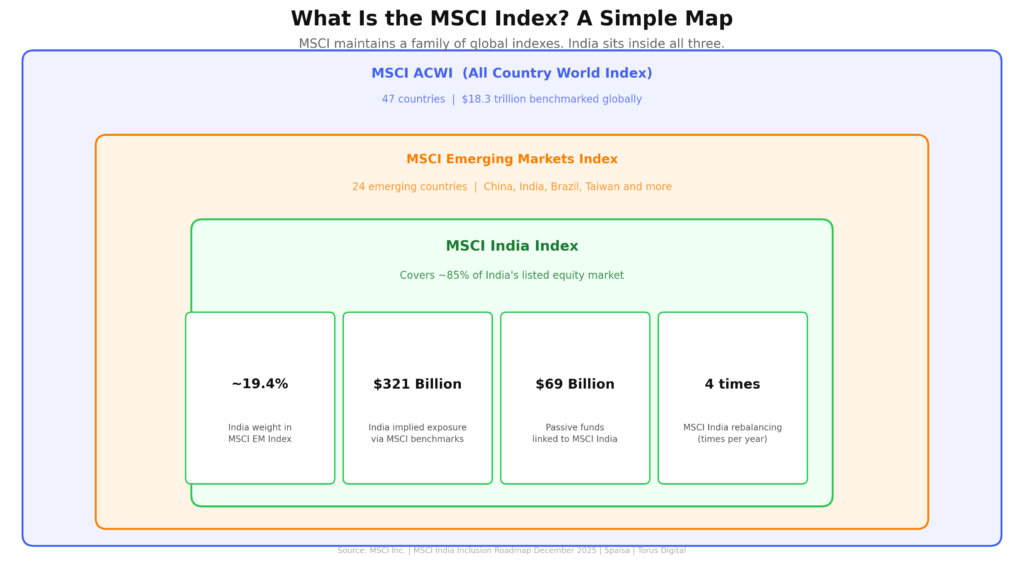
The biggest is called the MSCI ACWI, or All Country World Index. It covers 47 countries and about $18.3 trillion of global investment money is benchmarked to it.
Inside that sits the MSCI Emerging Markets Index. This covers 24 developing countries including India, China, Taiwan, and Brazil. Thousands of global funds use it as their benchmark.
And then there is the MSCI India Index. This tracks roughly 85 percent of India’s entire listed equity market.
India currently carries a weight of about 19.4 percent inside the MSCI Emerging Markets Index. That means for every 100 rupees a global emerging market fund invests, about 19 rupees goes into Indian stocks. As of late 2025, total implied exposure to Indian stocks through MSCI benchmarks is estimated at $321 billion, of which $69 billion comes from purely passive funds.
How does MSCI decide which stocks to include?
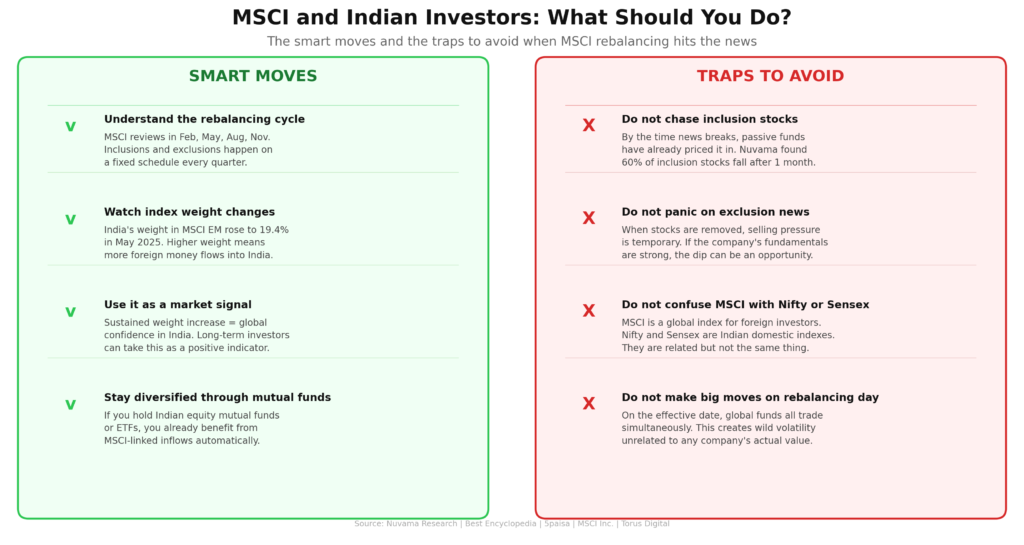
MSCI reviews its indexes four times a year. February, May, August, and November. During each review it looks at every listed company and asks a few simple questions.
Is the company big enough? Is the stock liquid enough to trade in large quantities? Does it meet MSCI’s rules around foreign ownership limits?
If a company qualifies and has grown large enough, it gets added. If it shrinks or fails to meet criteria, it gets removed.
In May 2025, two Indian companies were added to the MSCI Global Standard Index. Coromandel International, a fertiliser manufacturer, and Nykaa, the beauty and fashion platform. The moment the announcement was made, Nykaa’s shares jumped 3 percent in a single day. Not because anything changed at the company. Simply because the list changed.
What happens when a stock gets added to MSCI?
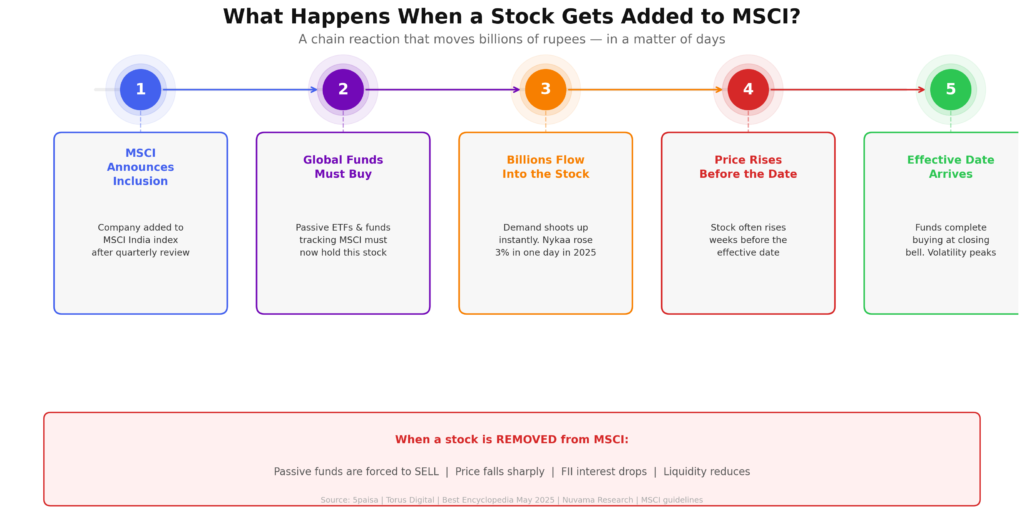
When MSCI adds an Indian stock to its index, every passive fund tracking that index must now buy that stock. These are giant global ETFs managing hundreds of billions of dollars. They are required to hold every stock in the index in the right proportion.
So suddenly billions of dollars are chasing a stock that was not on anyone’s mandatory list the week before. Demand shoots up. Price rises. Liquidity improves. This is why stocks often start rising days or weeks before the actual inclusion date.
But when a stock gets removed, the opposite happens. Every passive fund must sell. Billions exit within days. Prices fall, sometimes sharply, for reasons that have nothing to do with the company’s actual business.
How does this affect the broader Indian market?
The impact goes well beyond individual stocks.
When India’s weight in the MSCI Emerging Markets Index increases, global funds automatically put more money into India. Even a fund manager with no strong opinion on India still has to buy more Indian stocks because the index says so. This brings steady, structural inflows not driven by news or sentiment.
When India’s weight falls, money automatically moves out. This happens if India’s market grows slowly while other emerging markets grow faster. China or South Korea gaining weightage can directly mean India losing it.
On rebalancing days, when all global funds execute their trades simultaneously at the closing price, Indian markets can see wild swings that have nothing to do with Indian economic conditions. The 850-point Sensex fall at the start of this article happened on exactly such a day.
What does this mean for you as an Indian investor?
Here is the honest answer.
If you invest through Indian mutual funds or equity ETFs, you are already indirectly benefiting from MSCI-linked inflows. When foreign money flows into Indian stocks through MSCI, prices rise across the market and your portfolio benefits without you doing anything.
But trying to trade around MSCI announcements is a risky game. By the time you read about an inclusion in the news, institutional traders have already positioned themselves. A study by Nuvama Research found that after one month of rebalancing, 60 percent of freshly included stocks had already settled at a loss compared to the announcement-day price.
Similarly, selling an excluded stock purely because MSCI dropped it can be the wrong move if the company is fundamentally healthy. The selling pressure is mechanical and temporary. Prices often recover once the rebalancing dust settles.
The most sensible approach is to understand MSCI as a background force that brings or takes away foreign money, watch India’s weightage trend as a long-term confidence indicator, and stay focused on the quality of companies you own rather than which list they appear on.
For investors who rely on positional calls Indian stock market, MSCI reviews should be treated as an important calendar event rather than a trading strategy. Knowing when global index rebalancing takes place can help explain unusual volatility, but investment decisions should continue to be driven primarily by business fundamentals and long-term trends.
A simple closing thought
The MSCI Index is one of the most powerful forces in Indian markets that most investors have never thought about.
It does not care about quarterly earnings or budget announcements. It simply updates its lists four times a year. But when it does, trillions of dollars move accordingly.
India’s growing weight in the MSCI Emerging Markets Index is a quiet but meaningful signal. It means the world’s largest investors are being pushed to hold more of India with each passing review. That structural story matters far more for the long-term Indian investor than any single rebalancing event.
The next time Sensex moves sharply for no obvious reason, there is a good chance MSCI just updated its list.