
Every investor hears this line at some point.
“The Nifty PE is high” or “the market looks cheap.”
But what does that actually mean in real life?
Let’s break down the parts that usually confuse beginners.
Why “Nifty at 25,000” Means Nothing
When someone says “Nifty is at 25,000,” it sounds important.
But on its own, that number is almost useless.
Think of it like hearing a business is selling for ₹1 crore.
Is that cheap or expensive? You cannot tell yet.
Now imagine you also learn the business earns ₹10 lakh every year.
Suddenly, the price starts making sense.
That is exactly what the PE ratio does.
It connects price with earnings and gives the number meaning.
What PE Actually Means in Simple Terms
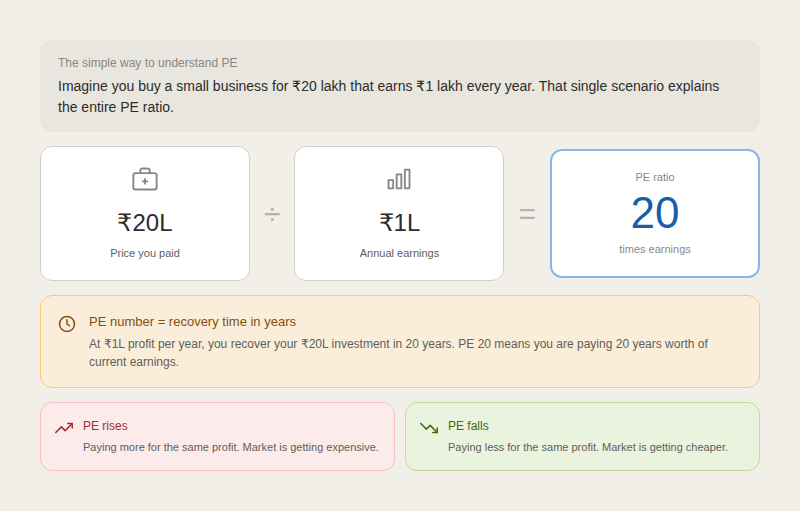
The easiest way to understand PE is this.
If you pay ₹20 lakh for a business that earns ₹1 lakh every year,
you are effectively paying 20 times its yearly profit.
That is a PE of 20.
Another way to think about it is recovery time.
At the current earnings level, it would take you 20 years to earn back what you paid.
So when the PE goes up, you are paying more for the same earnings.
When it goes down, you are paying less.
Simple.
Why High PE Is Not Always Bad
A high PE does not automatically mean the market is overpriced.
Sometimes investors are willing to pay more because they believe future profits will grow fast.
They are not buying today’s earnings. They are buying tomorrow’s potential.
This is where even a SEBI registered stock trading advisor would tell you that valuation must always be seen alongside future earnings expectations, not in isolation.
As long as those future profits actually come, the higher PE can be justified.
But if that growth does not show up, reality hits.
And that is when markets correct, sometimes sharply.
Why Low PE Is Not Always a Bargain
Low PE looks attractive on the surface.
But cheap does not always mean value.
Sometimes earnings are falling.
Sometimes the economy is weak.
Sometimes uncertainty is high.
In those cases, the market is not offering a bargain.
It is simply pricing in problems.
That is why a low PE only works in your favor when earnings eventually recover.
The 2021 Calculation Change That Confuses Everyone
There is one technical detail that trips up a lot of people.
In 2021, the way the PE ratio is calculated was changed.
Earlier, only standalone profits were counted.
Now, profits from subsidiaries are included as well.
Because of this, earnings suddenly looked higher.
And the PE dropped overnight.
But nothing actually became cheaper.
Only the calculation changed.
So if you compare today’s PE with older data without adjusting for this,
you may wrongly assume the market is cheaper than it really is.
Why PE Goes High Even in Bad Times
This feels confusing at first.
Take the COVID period as an example.
Company profits fell sharply.
But stock prices did not fall as much.
Since PE depends on earnings, lower profits pushed the PE higher.
So a high PE does not always mean the market is overheated.
Sometimes it simply means earnings are temporarily weak.
Why PE Cannot Predict Market Timing
Many beginners assume:
High PE means market will fall soon.
Low PE means market will rise soon.
It does not work like that.
The PE ratio only tells you whether the market looks expensive or cheap compared to the past.
It does not tell you when things will change.
Even for short term positional trading advice, relying only on PE can be misleading because short-term moves are driven more by sentiment, liquidity, and news flow.
Markets can stay expensive for a long time if growth continues.
And they can stay cheap for years if conditions remain weak.
Trying to time the market using PE alone usually leads to mistakes.
Why Sector Differences Matter
Not all businesses deserve the same PE.
Some sectors grow faster and naturally trade at higher valuations.
Others are cyclical and trade at lower valuations.
As the mix of companies in the Nifty changes over time,
the overall PE also changes.
That is why comparing today’s PE with very old data is not always fair.
What “Fair Value” PE Really Means
When the PE is around its long-term average,
the market is in a balanced zone.
Not too expensive.
Not too cheap.
In such conditions, expecting extreme returns or sharp crashes is not realistic.
A more moderate outcome is likely.
How You Should Actually Use PE
The smartest way to use PE is not to react emotionally,
but to adjust your expectations.
If the PE is high, you stay a bit cautious.
If it is low, you look more closely for opportunities.
If it is average, you continue normally.
But you do not stop investing completely.
Especially not your SIP.
Because the biggest mistake investors make is waiting for the perfect moment.
And that moment rarely comes when you expect it.
The One Thing to Always Remember
The PE ratio is like a thermometer.
It tells you if the market feels hot or cold.
But it cannot tell you what will happen next.
Good investors do not panic because of it.
They simply pay attention, stay consistent, and let time do the heavy lifting.
That is where real wealth gets built.