Every year, Mumbai waits for the monsoon.
Builders pray the rains hold off so construction does not stop. Farmers near the city need rain to save their crops. Umbrella sellers hope for a wet season. Power companies watch the sky to see if hydro energy reserves will hold.
For centuries, all these people shared one thing in common. Whatever the monsoon gave them, they simply had to accept it.
Until now.
On May 29, 2026, something genuinely new arrived in Indian financial markets. A contract called RAINMUMBAI. For the first time in India’s history, you can now take a financial position on how much it rains in Mumbai. And actually get paid if you are right.
While RAINMUMBAI is very different from positional calls Indian stock market investors usually follow, it shows how India’s financial markets are expanding beyond stocks and commodities.
This is not a gimmick. It is a serious financial instrument approved by SEBI, built using real data from the India Meteorological Department, and developed in collaboration with IIT Bombay.
Let us understand exactly what it is, how it works, and who it is meant for.
Start with a simple story
Picture two people standing at the same window during monsoon season.
One is a construction site manager. Heavy rain means his workers sit idle. His deadlines slip. His costs pile up. Every extra rainy day costs him lakhs.
The other is a fertiliser dealer. A poor monsoon means farmers do not plant as much. They buy less fertiliser. Her revenue drops.
Same rain. Completely opposite problems.
Before RAINMUMBAI, both of them had only one option. Hope for the best. Maybe buy traditional insurance, which requires you to prove actual physical damage, wait for a surveyor to visit, and file a claim that could take months.
RAINMUMBAI changes that completely. Instead of proving damage, you simply take a financial position on the rain. If the rain behaves as you feared, you get paid automatically. No forms. No surveyor. No waiting.
That is the core idea.
So what exactly is RAINMUMBAI?
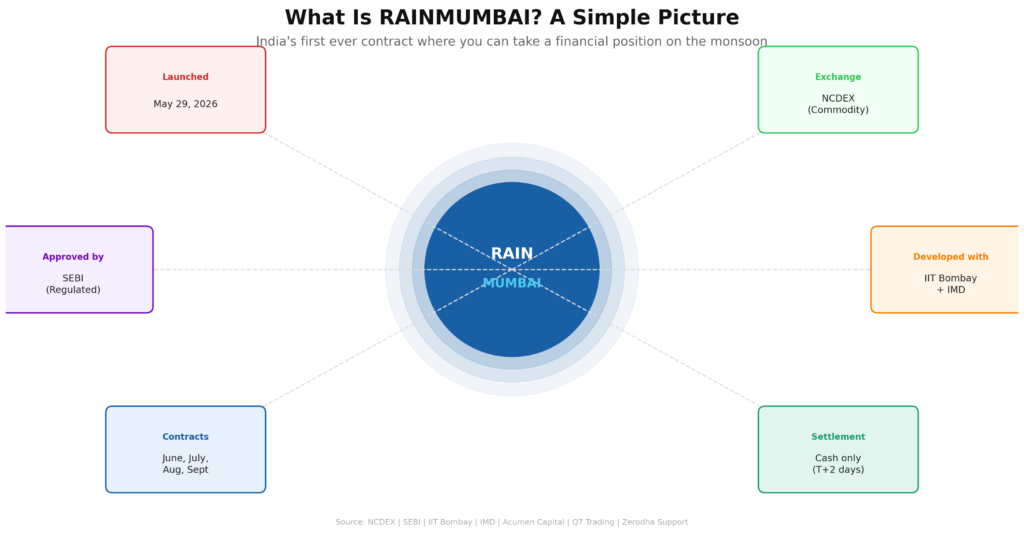
RAINMUMBAI is India’s first exchange-traded weather derivative contract. It is listed on NCDEX, which stands for National Commodity and Derivatives Exchange. It has been approved by SEBI and is available to trade by all registered participants including retail investors.
In plain language, it is a futures contract. You buy or sell it based on where you think Mumbai’s monsoon rainfall will land relative to its historical average.
The contract runs during the four monsoon months only. June, July, August, and September. There is a separate contract for each month. At the end of each contract month, it is settled automatically in cash. No physical delivery. No commodity changes hands. Just a number, a calculation, and a cash transfer.
The entire process is powered by official rainfall data recorded every single day by the India Meteorological Department at two Mumbai weather stations. Santacruz and Colaba. These are among the oldest and most trusted weather stations in the country.
The one number that runs the whole thing
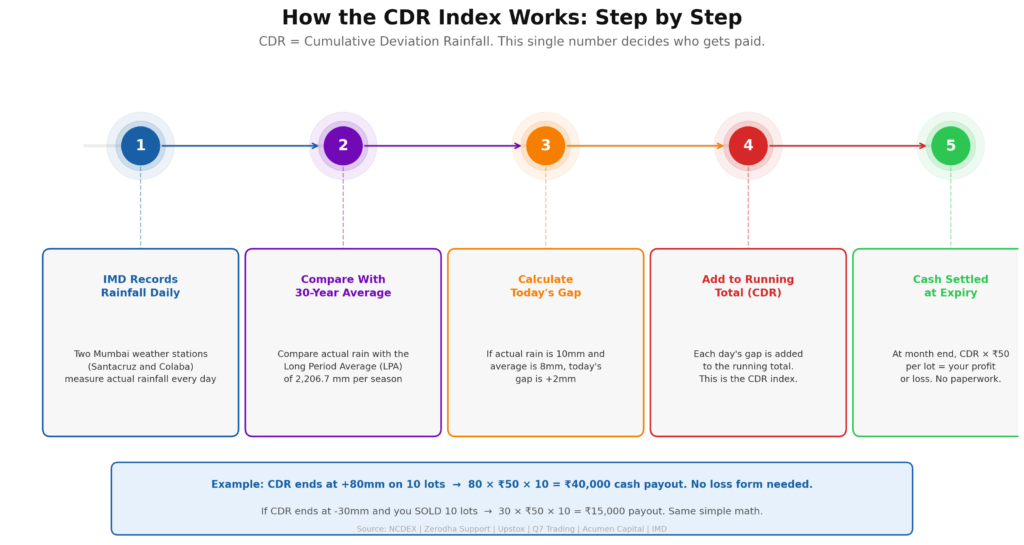
To understand RAINMUMBAI, you need to understand one term. CDR.
CDR stands for Cumulative Deviation Rainfall. It sounds technical. The idea behind it is beautifully simple.
Mumbai gets a certain amount of rain every monsoon season on average. This average was calculated using 30 years of historical data from 1991 to 2020. The number comes out to 2,206.7 mm of rainfall across the full June to September season. This is called the Long Period Average or LPA.
Every single day during the monsoon, the IMD checks how much it rained in Mumbai that day. Then it compares that figure against what was historically normal for that specific date.
If it rained more than normal today, the gap is a positive number. If it rained less, the gap is negative. This daily gap gets added to a running total. That running total is the CDR index.
Think of it like a bank account for rainfall. Every day of surplus adds money. Every day of deficit takes money away. At the end of the contract month, whatever the final balance is, that is the number used to settle the contract.
Each millimetre of CDR is worth Rs 50 per lot. So if the CDR ends at positive 80mm at the end of June and you bought 10 lots, your payout is 80 times Rs 50 times 10 lots. That equals Rs 40,000. Paid in cash automatically within two working days. No claim required.
How does this help real businesses?
Let us go back to our construction site manager.
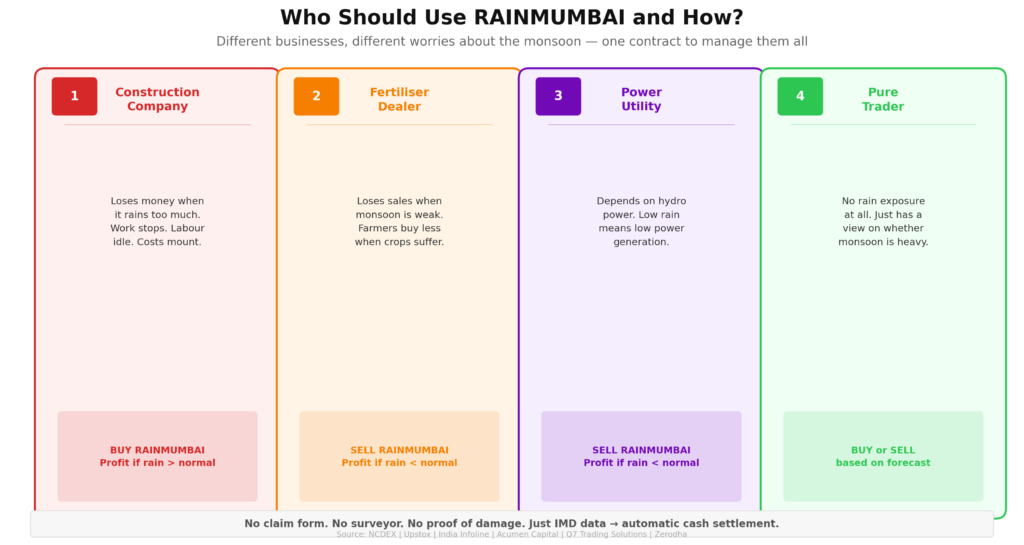
His problem is too much rain. When it rains more than normal, his costs rise. So he buys RAINMUMBAI contracts. If the monsoon turns out to be heavier than the historical average, the CDR ends positive. He gets a cash payout that helps offset his losses on the ground.
If the monsoon is actually lighter than expected, the CDR ends negative. He loses the contract. But in that case, his site ran without major delays anyway. His construction work went smoothly. The contract loss is affordable because his actual business did well.
Now take our fertiliser dealer.
Her problem is too little rain. A weak monsoon means farmers reduce crop activity. They buy less fertiliser. Her revenue drops. So she sells RAINMUMBAI contracts. If the monsoon is weaker than the historical average, the CDR ends negative. She profits from the contract and cushions the blow to her actual business.
If the monsoon is surprisingly heavy, she loses the contract. But bumper rains mean bumper crop activity. Farmers buy more fertiliser. Her business is doing well anyway.
This is the elegant logic of weather derivatives. The contract moves in the direction of your risk. When your business suffers, the contract pays. When your business is fine, you can afford to lose the contract.
What makes this better than traditional insurance? No damage declaration. No surveyor visit. No waiting months for a claim. The IMD reads the sky, NCDEX does the math, and the money moves within two days.
Who should use RAINMUMBAI?
NCDEX has identified a wide range of businesses that could benefit from this contract.
Construction companies that lose working days when it rains heavily are natural buyers. Power utilities that depend on hydroelectric generation and suffer when the monsoon is weak are natural sellers. Banks with large agricultural loan portfolios that face higher defaults during droughts benefit from selling the contract. Logistics companies whose deliveries are disrupted by flooding are natural buyers.
Even retail traders with no rain exposure at all can participate. Someone who simply believes the 2026 monsoon will be stronger than the historical average can buy the contract and sell it if their prediction is correct. This speculative participation is important because it provides liquidity for the hedgers. Markets need both sides to function smoothly.
How do you actually trade RAINMUMBAI?
To trade RAINMUMBAI, you need a demat and commodity trading account with a SEBI-registered broker that offers access to the NCDEX platform. This is different from a regular equity trading account. You specifically need commodity segment activation.
Once your account is ready, you search for the RAINMUMBAI contract on the NCDEX platform. You choose the month you want, June, July, August, or September. You decide whether to buy or sell based on your rainfall view or hedging need. You place your order.
Like all futures trading, you do not pay the full contract value upfront. You pay a margin amount, which is a fraction of the total value. The initial margin required is approximately 10 percent of the initial contract value.
The contract trades from 10 AM to 11:55 PM on weekdays. The daily price limit is 6 percent initially, expandable to 9 percent in total.
One important thing to note. This is a more complex product than a simple equity stock. Understanding the CDR formula, how the LPA works, and which direction to take a position requires some study before your first trade. NCDEX and most registered brokers provide educational material specifically for RAINMUMBAI.
A few things to remember
RAINMUMBAI is a Mumbai-only contract for now. It only tracks rainfall at the Santacruz and Colaba stations. If your business is based entirely outside Mumbai’s catchment area, the contract may not perfectly reflect the rainfall affecting you.
It also does not track absolute rainfall. It tracks deviation from the historical average. So a year that gets 2,000 mm of rain sounds like a lot but if the average is 2,206 mm, it would actually register as a deficit year. Your position direction must align with this relative measure, not your gut feeling about whether it will rain heavily.
NCDEX has indicated this is just the beginning. Future plans include expanding to other cities and developing temperature-based contracts for northern India.
Although RAINMUMBAI is primarily designed as a hedging tool, it may also attract experienced traders who already use short term trading strategies in futures markets. However, unlike price-based trading, success here depends on understanding rainfall data, seasonal patterns, and how the CDR index is calculated—not just technical charts.
A simple closing thought
For centuries, Indian businesses have watched the monsoon sky with either hope or dread. Revenue, harvest, safety, and survival have all depended on something nobody could control.
RAINMUMBAI does not control the weather. Nobody can do that.
But for the first time in India’s financial history, it gives businesses a proper, regulated, science-backed tool to manage the financial consequences of that weather.
India joined the global weather derivatives market on May 29, 2026. The sky above Mumbai is still the same. The way businesses can prepare for it has changed forever.