Open your trading app right now. Look up any large company. Reliance, TCS, Maruti, anything.
Now check the same stock on NSE and on BSE.
Chances are the prices are not exactly the same. Maybe just a few paise apart. Sometimes a rupee or two. Same company. Same shares. Same business. Different price tags, sitting side by side on your screen.
Most investors notice this once, feel confused for a second, and move on. But there is a genuinely interesting reason behind it. And once you understand it, you understand something important about how markets actually work.
First, what are NSE and BSE exactly?
India has two major stock exchanges. BSE, the Bombay Stock Exchange, is the older one. It was set up way back in 1875, making it one of the oldest exchanges in all of Asia. NSE, the National Stock Exchange, came much later, in 1992, and was built specifically to bring modern electronic trading to India.
Think of them like two separate supermarkets selling the exact same brand of biscuits. The biscuits are identical. The company making them is the same. But the supermarkets are run by different owners, have different customers walking in, and operate slightly differently.
Most large Indian companies list their shares on both exchanges. You can choose to buy or sell on either one.
So why is the price not exactly the same?
Here is the simple answer. Price comes from buyers and sellers meeting at a number both sides agree on. NSE and BSE are two separate marketplaces. They have their own separate pool of buyers and sellers.
If, at a certain moment, NSE has slightly more buyers wanting a stock and BSE has slightly more sellers willing to let it go, the prices on the two exchanges will drift apart by a tiny amount. NSE’s price ticks up. BSE’s price stays a touch lower. Just for a moment.
It is exactly like two vegetable markets in the same city. The tomatoes are identical. But if one market suddenly gets a rush of buyers and the other does not, prices in that market can move up slightly faster, even if only for a few minutes.
NSE is the bigger and busier of the two. It has far higher trading volumes and many more participants buying and selling every second. BSE has fewer trades happening on most stocks at any given time. That difference in crowd size is one of the simplest reasons prices can drift apart slightly between the two.
The gap rarely lasts. Here is why.
You might think, why does nobody just buy on the cheaper exchange and sell on the costlier one to make easy money?
People do exactly that. It is called Arbitrage. And it is one of the oldest tricks in financial markets.
Professional traders and investors using short term stock trading advisory services often track these small price differences, looking for opportunities before they disappear.
Here is how it plays out. Suppose Reliance is trading at ₹1,500 on BSE and ₹1,502 on NSE at the same second. A trader notices this gap. They quickly buy the share on BSE at ₹1,500 and sell it on NSE at ₹1,502. That is a profit of ₹2 per share, locked in immediately, with almost no risk.
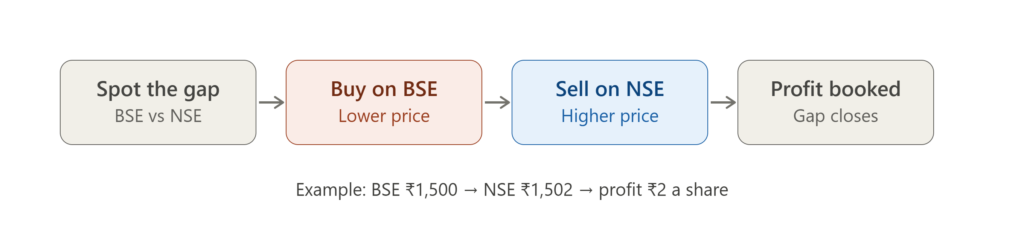
Sounds great. But here is the catch. The moment that trader buys on BSE, they add one more buyer to that exchange, nudging its price up slightly. The moment they sell on NSE, they add one more seller there, nudging that price down slightly. If a thousand other traders are doing the exact same thing within the same few seconds, using fast computers and algorithms, the gap between the two prices closes almost instantly.
This is why huge, profitable price gaps almost never survive for long on large, popular stocks. There are simply too many sharp traders watching every tick, every second, ready to pounce on any gap before you have even finished reading this sentence.
A real rule change that quietly fixed a big chunk of this
For years, there was an extra wrinkle in this story. Indian regulations did not allow you to buy a stock on one exchange and sell the very same shares on another exchange within the same trading day. You had to buy and sell on the same exchange if you wanted to do it as an intraday trade.
That changed when SEBI introduced what is called interoperability between exchanges, allowing trades and settlements to flow more smoothly between NSE and BSE. Today, several brokers allow you to buy on NSE and sell on BSE, or the other way around, even within the same day, as long as your broker supports this feature.
This single change made arbitrage faster and smoother than it used to be. It also means price gaps between the two exchanges close even quicker than before, because more traders can now jump on a gap the moment they spot it.
Why the gap is almost always tiny
Here is the honest truth about this entire topic. The price difference you see between NSE and BSE on any large, frequently traded stock is usually so small that it barely matters to a normal investor. A few paise. Occasionally a rupee or two on an expensive stock.
The gap exists because the two exchanges are technically separate marketplaces with separate order books. But arbitrage traders, often running automated systems that react within milliseconds, keep closing that gap almost as fast as it opens. By the time a regular retail investor notices the difference and tries to act on it, the gap has usually already shrunk or vanished. Brokerage charges and other costs on a small trade can also quietly eat up whatever tiny profit might have been available.
This is not a flaw in the system. It is actually proof that the system is working well. A market where prices for the identical stock can diverge wildly between two exchanges, for long periods, would be a market with serious problems. The fact that the gap stays tiny and short-lived shows that information and money move quickly and efficiently across Indian markets.
Understanding this price difference can help when evaluating research from a SEBI registered trading advisory in India, since these small gaps are usually closed within seconds by arbitrage traders.
Does it matter which exchange you trade on?
For most regular investors, honestly, not much. Your long-term return depends entirely on how the company performs, not on whether your particular order matched on NSE or BSE.
That said, a few small practical differences are worth knowing. NSE usually has higher trading volumes for large companies and most derivatives trading. BSE has a wider universe of listed companies, including many smaller ones that may not be available on NSE at all.
The bigger lesson hiding in this small detail
The next time you spot a tiny price difference between NSE and BSE for the same stock, do not see it as confusion or as a mistake in the system. See it as a small, quiet window into how markets actually behave.
Two separate marketplaces. Slightly different sets of buyers and sellers at any given moment. A tiny gap that opens for a few seconds. And an army of traders racing to close that gap almost the instant it appears.
That tiny rupee or two of difference on your screen is not random. It is the visible fingerprint of thousands of trades happening every second, constantly nudging prices back toward agreement. It is one of the simplest, most everyday examples of how efficient and alive Indian stock markets really are.