
In India, your mother probably had a dabba. An old steel box or biscuit tin sitting quietly in the back of a cupboard. Some cash notes folded inside. A gold chain. Maybe a fixed deposit receipt. Nobody touched it. Nobody reviewed it. Years later, when a real need arrived, that dabba quietly delivered.
That simple Indian habit is the oldest and wisest form of investing there is. And someone gave it a proper name.
Coffee can investing.
Interestingly, this philosophy has gained renewed attention in recent years, especially as more investors look to balance their portfolios. Even those who actively follow stock advice for swing trading to generate short-term gains often keep a separate long-term bucket of quality businesses that they never touch. Many people realize that real wealth is built by patiently holding great businesses for years while letting compounding do the heavy lifting.
The story behind the idea
In the mid-1950s, an American investment advisor named Robert Kirby discovered something unexpected while managing a client’s portfolio. When that client’s husband passed away, Kirby was asked to handle his investments too.
The husband had been secretly copying every stock Kirby recommended to his wife. But with one twist. He only followed the buy advice. Every sell recommendation was ignored. After buying each stock, he put the certificate in a safe deposit box and forgot it existed.
The result? A few holdings were worth almost nothing. But one, a small company called Haloid that later became Xerox, was worth more than the entire portfolio of the wife who had followed professional advice perfectly.
The man who did nothing, won.
In India, this idea was shaped brilliantly by Saurabh Mukherjea, founder of Marcellus Investment Managers. His 2018 book “Coffee Can Investing: The Low Risk Road to Stupendous Wealth” brought this philosophy into Indian homes in a language every investor could understand.
As Mukherjea points out, Indian middle-class families had been doing this for generations. Storing savings in dabbas and tins. Never touching them. Pulling them out years later for a wedding or emergency. Same principle. Different container.
What it actually means
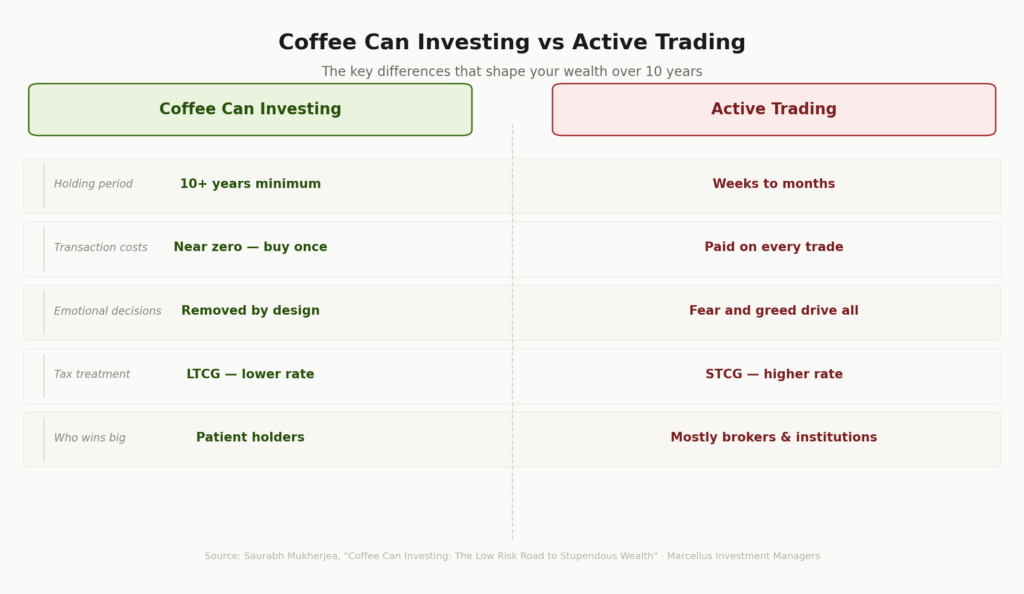
The idea is simple. You pick a small group of excellent Indian companies. You buy their shares. Then you mentally lock them in a coffee can and leave them completely untouched for at least ten years.
No selling when the Sensex crashes. No panic during budget announcements. No reacting to quarterly results or WhatsApp stock tips. Just hold. For a decade.
This is the direct opposite of how most Indian retail investors behave. Most investors check their apps every day. Sell in fear during downturns. Buy excitedly during rallies. Churn their portfolio every few months based on headlines that are forgotten within a week.
Every transaction costs money. Every emotional decision costs returns. Coffee can investing eliminates both.
Why doing nothing actually works
Three reasons make this strategy genuinely powerful.
First, compounding. When a great Indian company grows its profits year after year, those profits get reinvested and create more profits. Over ten or twenty years, a company growing at even 15 percent per year becomes worth many times what you paid. But you have to stay in long enough for the curve to bend sharply upward. Selling at year three cuts the process off before the real magic begins.
Second, you protect yourself from your own worst instincts. The biggest destroyer of retail investor returns is not bad companies. It is bad decisions made during scary moments. Selling during the 2008 crash. Exiting during COVID in March 2020. Every one of those exits locked in losses and missed the recovery that followed. Coffee can investing removes the option to make those mistakes.
Third, cost savings compound too. Every trade in India costs money. Brokerage fees, Securities Transaction Tax, GST, and short-term capital gains tax if held under a year. A coffee can investor pays entry costs once and almost nothing for ten years after that. Those saved costs quietly compound alongside the portfolio.
What patient investors actually made
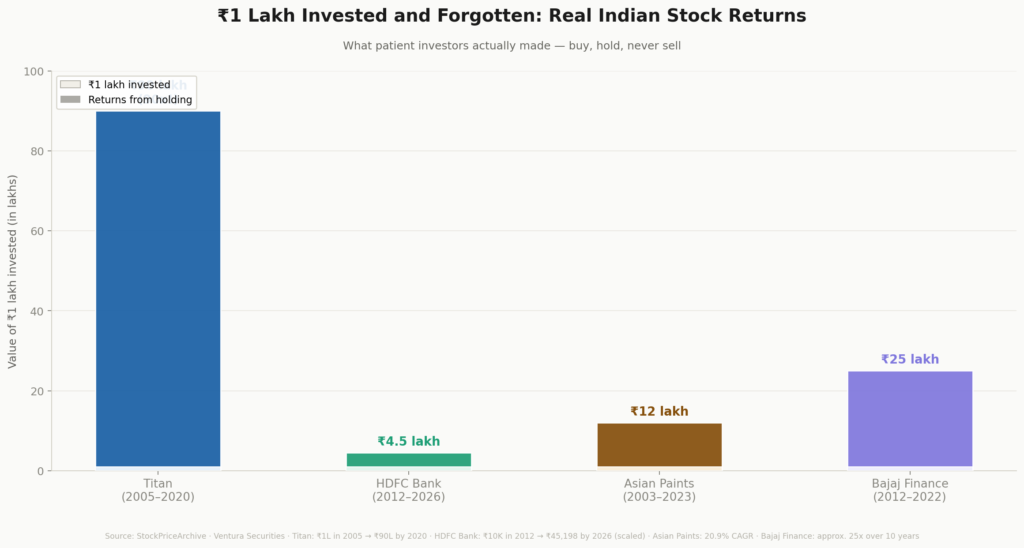
India’s market has produced some of the most dramatic long-term returns in the world for those who simply held quality companies.
One lakh rupees invested in Titan in 2005 and held until 2020 grew to approximately ninety lakh rupees. Not ninety thousand. Ninety lakh. Asian Paints has compounded at roughly 20.9 percent per year since 1990. Ten thousand rupees in HDFC Bank in 2012 grew to over forty-five thousand by 2026. Bajaj Finance held patiently over a decade returned approximately twenty-five times.
Goldman Sachs found that India had the highest proportion of multibagger stocks among all major global markets. More than half of NSE 500 companies achieved ten-times returns in at least one rolling five-year period over the past two decades.
These returns did not come from clever trading. They came from buying quality and refusing to sell.
How to actually build one
The holding is passive. The selection upfront is serious.
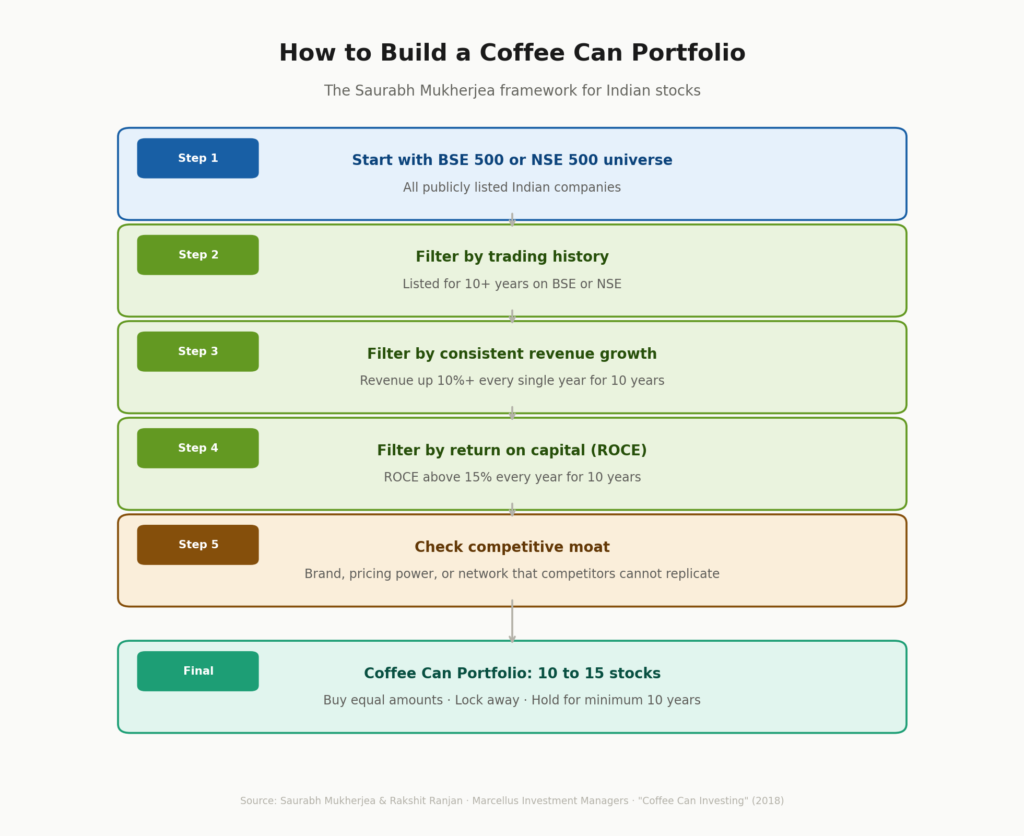
Saurabh Mukherjea and the Marcellus team developed a clear filtering framework for Indian stocks. It works like a funnel.
The company must have been listed on BSE or NSE for at least ten years. Revenue must have grown by at least ten percent every single year for the past decade. Not on average. Every year. The Return on Capital Employed, or ROCE, must have been above fifteen percent every single year for ten years. This tells you the business earns well without constantly needing to borrow or dilute shareholders.
Finally, the company must have a durable competitive advantage. Something that makes it genuinely hard for competitors to take its customers. Asian Paints has a distribution network and brand trust built over seven decades. Pidilite has Fevicol, whose name has become synonymous with adhesive in every Indian household. HDFC Bank has the institutional discipline that took decades to build. These moats do not disappear in one bad quarter.
From this filtered universe, a coffee can portfolio holds ten to fifteen stocks in roughly equal amounts and is left untouched for a minimum of ten years.
The real challenge is holding, not picking
During the 2008 financial crisis, the Nifty fell over sixty percent. Coffee can investors held. By 2010, markets had recovered. In March 2020, the Nifty crashed nearly forty percent in weeks. Coffee can investors held. By end of that year, markets were at all-time highs.
In every single case, the investor who held quality companies through the fear came out far ahead of the one who sold and tried to re-enter at the right time.
But honest disclosure is necessary here. The strategy fails if you select the wrong companies in the first place. Kingfisher Airlines looked exciting once. Several PSU banks have quietly destroyed patient shareholder wealth over decades. The filters help, but no checklist is perfect.
The strategy also needs a genuine ten-year commitment. If you need this money in three or five years, this is not the right approach for it. And it demands a psychological stillness that most investors underestimate. Watching your stock fall forty percent while every news channel declares it doomed, and doing absolutely nothing, is harder than it sounds.
This is why successful investors spend less time chasing stock tips and more time finding great businesses. Whether you invest on your own or seek guidance from the best stock advisor in India, the principle remains the same: buy quality companies and give them time to compound.
A simple closing thought
The Indian dabba investor never read a balance sheet. She never tracked quarterly results. She put something valuable away, refused to touch it, and trusted time to do the rest.
The coffee can investor does exactly the same. Only with a bit more structure upfront and a longer runway ahead.
India’s best companies are quietly compounding their earnings every single year. Whether you are watching or not. Whether markets are up or down. Whether the news is good or terrifying.
Your only job is to own them and stay out of the way.