You love gold.
Every Indian does.
But let’s be honest about what owning gold actually looks like.
You buy it from a jeweller. You pay 3% GST upfront. You pay making charges. You take it home, worry about keeping it safe, and then rent a bank locker.
And if something goes wrong?
The bank compensates you for roughly ₹2 to ₹5 lakh. No matter how much gold was actually in there.
That’s the reality of physical gold in India.
There is a better way now.
On May 4, 2026, the National Stock Exchange launched something called Electronic Gold Receipts. EGRs.
Here’s exactly what they are and why they matter.
What Is an EGR? The Simplest Explanation
Think of it like this.
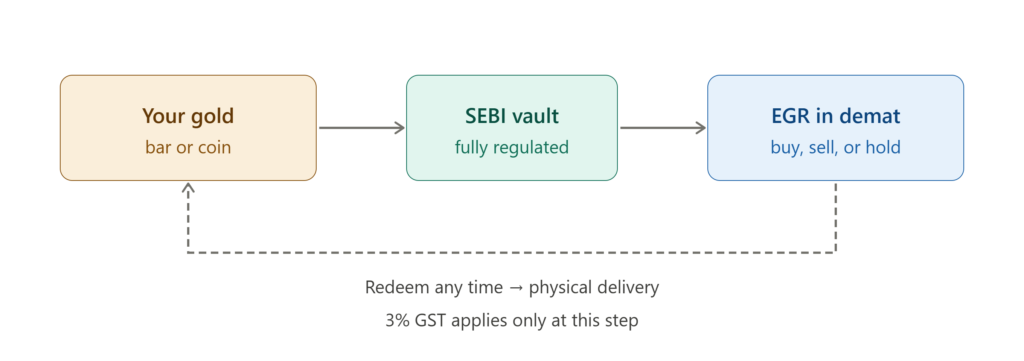
You own a gold bar. But instead of keeping it at home, you hand it to a SEBI-regulated vault. The vault gives you a digital receipt for it.
That receipt sits in your demat account.
You can buy it, sell it, or hold it. Just like a stock.
And whenever you want the actual gold back, you can withdraw it physically.
That receipt is an Electronic Gold Receipt.
The gold is real. It is sitting in a vault. SEBI regulates the entire process. Your receipt represents your ownership of that gold.
For investors who regularly follow market updates, expert share market tips, and alternative investment trends, EGRs are emerging as an important new asset class to watch.
The Three Problems With Physical Gold That EGRs Fix
Problem 1: You pay GST the moment you buy
Buy a gold coin today and you pay 3% GST immediately.
With an EGR, no GST applies when you buy or sell on the exchange.
GST of 3% only applies if and when you decide to convert your EGR into physical gold. If you never convert, you never pay GST.
Problem 2: Price confusion across India
Gold rates differ from city to city. Even from shop to shop.
With EGRs, the exchange sets one transparent price. One nation, one price. You can track it live on your broker app every single day.
Problem 3: Storage risk and bank locker limitations
Gold ETFs solved the storage problem but created a new one. You can never convert a Gold ETF back into physical gold. You only get the price exposure.
EGRs solve both. Your gold sits in a SEBI-accredited vault. Zero theft risk. Zero locker rental. And if you ever want the physical gold, you can actually get it.
How EGRs Work: Step by Step
Step 1: Open your broker app
EGRs trade on the NSE through your existing demat account. No new account needed. Check if your broker has activated the EGR segment, as it is being rolled out gradually.
Step 2: Buy in small amounts
EGRs are available in small denominations starting from 1 gram. You do not need lakhs to start. Buy 1 gram, hold it, and add more when you want.
Step 3: It sits in your demat account
Once you buy, the EGR is credited to your demat account. No storage cost. No locker rent. No worry.
Step 4: Sell anytime during market hours
EGRs trade on the exchange just like stocks. Buy when you want. Sell when you want. Real-time pricing. Settled on a T+1 basis.
Step 5: Convert to physical gold when needed
If you ever want the actual gold, request a withdrawal through your broker or vault manager. The gold is delivered from the SEBI-accredited vault. At this point, 3% GST applies on the value of gold being delivered.
EGR vs Gold ETF vs Physical Gold: The Honest Comparison
| Criteria | Physical gold | Gold ETF | EGR New on NSE |
|---|---|---|---|
| GST upfront | 3% on purchase | None | None until conversion |
| Making charges | Yes, always | None | None, confirmed |
| Storage | Locker rent + theft risk | None | Small vaulting fee |
| Get physical gold | Already physical | Price only, no delivery | Yes, from vault |
| Live price | Varies by shop or city | NSE / BSE | NSE live |
| LTCG period | 24 months | Check current rules* | 12 months |
Here is where most people get confused.
Gold ETFs are liquid and easy. But you can never take physical gold out. It is purely financial exposure.
Physical gold is tangible. But it comes with GST upfront, making charges, storage risk, and inconsistent pricing.
EGRs sit right in the middle.
Exchange-traded like Gold ETFs. Physically backed and redeemable like physical gold. No making charges. No upfront GST. No storage cost. Guaranteed purity of 995 or 999 fineness as per LBMA and India Good Delivery Standards.
One more advantage that most people are not talking about.
The holding period for long-term capital gains on EGRs is 12 months. For physical gold, it is 24 months. That is a meaningful tax advantage for investors who hold and sell within one to two years.
For investors who regularly follow insights from a SEBI registered investment advisor, this shorter holding period could make EGRs a more tax-efficient alternative compared to traditional physical gold investments.
What Are the Costs?
No product is entirely free. Here is what you should know.
You will pay brokerage when you buy or sell, the same as any stock trade. There may be vaulting charges for the storage of gold in the regulated vault. If you request physical delivery, GST of 3% applies at that point along with any logistics charges, which the vault manager discloses upfront.
No making charges at any stage. That is confirmed.
One Important Note Before You Buy
BSE launched EGRs first in October 2022. NSE added the segment on May 4, 2026.
Not all brokers have activated it yet.
Zerodha, for example, has confirmed EGR support is coming but was not live at the time of NSE’s launch announcement.
Check your specific broker app before you search for EGRs. If it is not showing up yet, it will be available soon as brokers roll it out over the coming weeks.
Also worth noting. EGRs have no expiry date. You can hold them in your demat account indefinitely.
Final Takeaway
India has always had a complicated relationship with gold.
We love it. We hoard it. We worry about it.
EGRs do not change what gold means to Indians. They change how we hold it.
The framework is simple:
Buy on the exchange with no upfront GST and no making charges.
Hold in your demat account with guaranteed purity and zero storage risk.
Sell anytime at a transparent national price during market hours.
Convert to physical gold whenever you actually need it.
For anyone who buys gold for investment and not just for jewellery, EGRs are a structurally cleaner way to own it.
The bank locker was always a poor substitute for a regulated vault.
Now you have a better option.