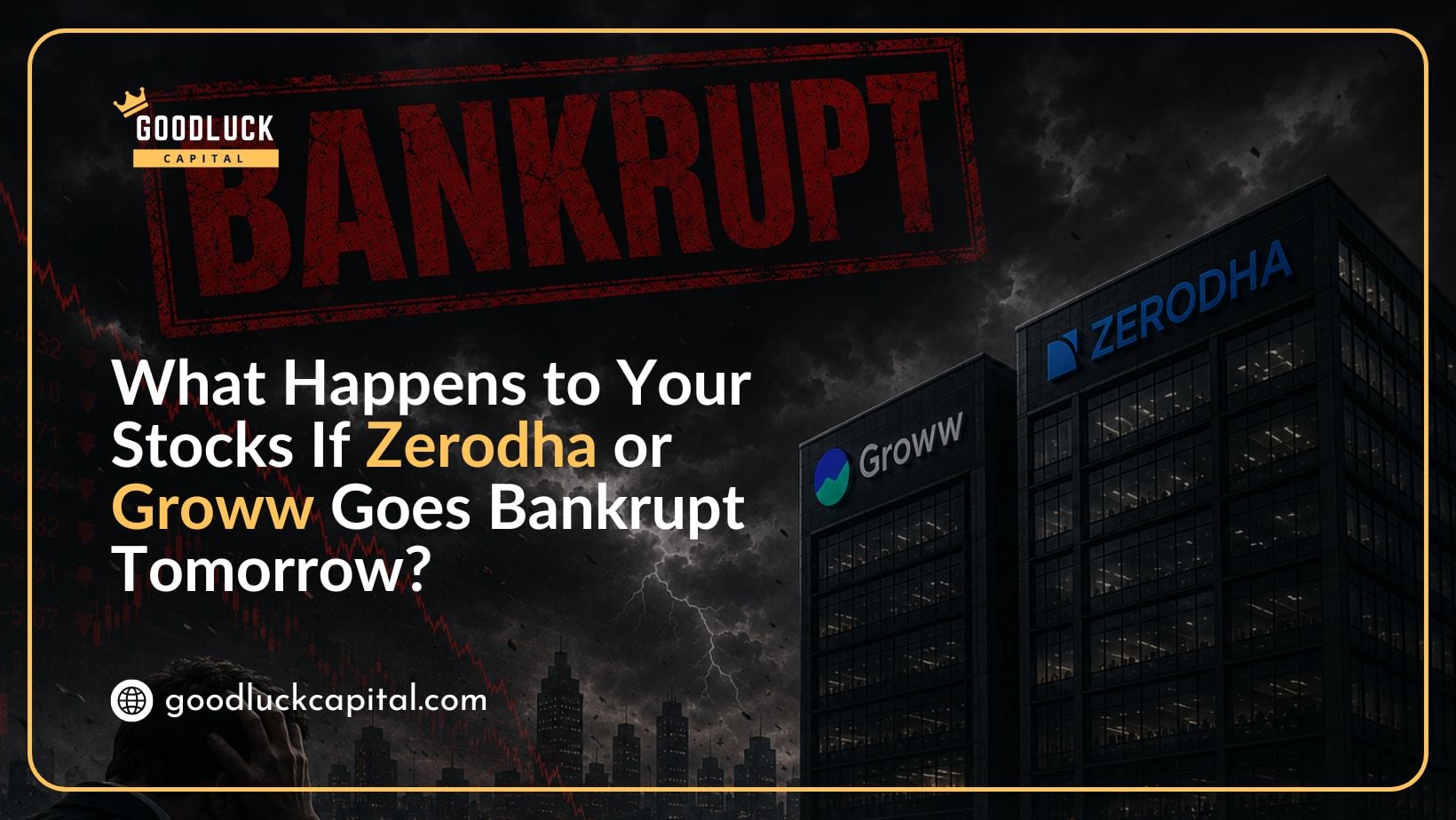
Let’s say you wake up one morning, open your phone, and see a news headline that stops your heart:
“Zerodha files for bankruptcy. Operations halted.”
Your first thought? “My stocks. What happens to my stocks?”
It’s a completely valid fear. You’ve been investing for months, maybe years. You’ve put in your hard-earned money. And now the app that holds everything might be gone.
Here’s the good news: your stocks are almost certainly safe. And once you understand why, you’ll never lose sleep over this again.
Let’s break it all down.
First, Let’s Clear Up a Big Misconception
Most people assume their stocks “live inside” Zerodha or Groww, the way money lives inside a bank account.
That’s not how it works.
Zerodha, Groww, Angel One, and every other broker in India are called stockbrokers or trading members. They are essentially middlemen. Their job is to help you buy and sell stocks on the stock exchange (NSE or BSE).
But they don’t actually hold your stocks.
So who does?
Meet the Real Custodians: CDSL and NSDL
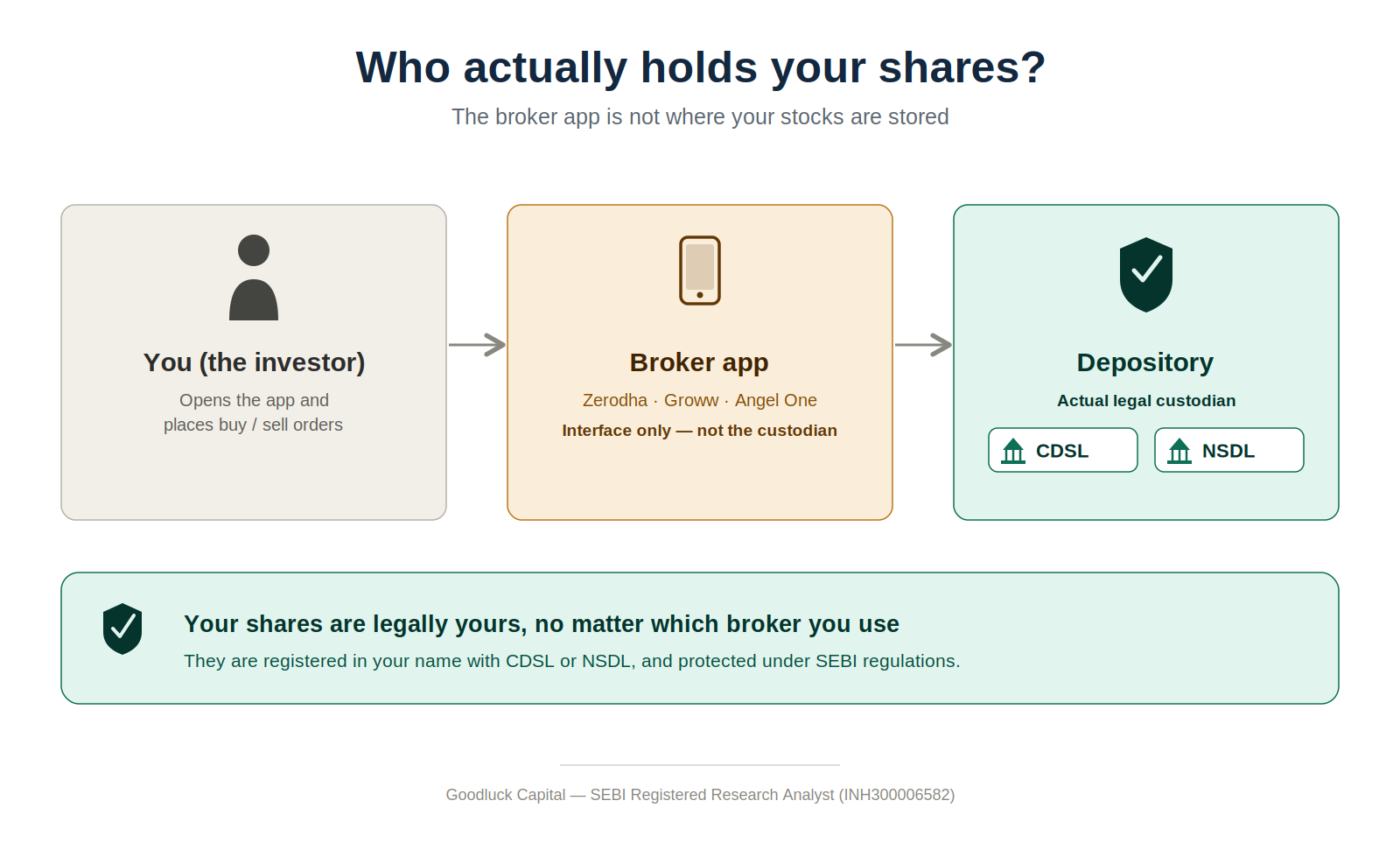
When you buy a share of Reliance or Infosys, that share doesn’t sit inside an app. It gets stored in your Demat account (short for Dematerialised account).
- CDSL: Central Depository Services Limited
- NSDL: National Securities Depository Limited
And your Demat account is maintained by one of two government-regulated depositories:
Think of them like the “banks” for your shares. Just like your money in a bank account is yours, your shares in a Demat account are legally yours.
Zerodha and Groww are just Depository Participants (DPs), who act as the bridge between you and CDSL or NSDL. They provide the interface, the charts, the buy/sell buttons. But the actual shares? Those are registered in your name with the depository.
So What Actually Happens If Zerodha Goes Bust?
Here’s the scenario played out, step by step:
Step 1: You open the app. It doesn’t work. The app is down. You’re locked out. Panic sets in.
Step 2: Your stocks are still there. Even if Zerodha shuts its doors permanently, your shares are still sitting safely in your Demat account with CDSL. They haven’t gone anywhere.
Step 3: SEBI steps in. The Securities and Exchange Board of India, India’s stock market regulator, has clear rules for exactly this situation. They would oversee the transition, protect your interests, and ensure you have access to your holdings.
Step 4: You transfer to another broker. You’d fill out a simple form to move your Demat account to another broker, like HDFC Securities or Angel One. Your stocks transfer intact. Nothing is lost.
The whole process might take a few weeks. It’s inconvenient. But your investments? They survive.
This Has Already Happened in India. Here’s What We Learned.
In 2019, a stockbroker called Karvy Stock Broking got into serious trouble. SEBI discovered that Karvy had misused client securities worth nearly ₹2,800 crore. It was one of the biggest stockbroker scandals in Indian history.
Millions of investors were terrified. But here’s what actually happened: SEBI stepped in immediately, froze Karvy’s operations, and worked to ensure client stocks were transferred safely to other brokers.
Yes, it was messy. Yes, there were delays. But investors did not lose their shares.
More importantly, after Karvy, SEBI tightened the rules significantly. Brokers are now under much stricter oversight. Audits are more frequent. The safety net is stronger.
In fact, if you’re still unsure about how your investments are protected or how to structure your portfolio, consulting a SEBI registered investment advisor can help you understand the safeguards built into India’s financial system and make more informed investment decisions.
But Wait: What About the Cash in Your Trading Account?
Here’s where things get a little more nuanced. Pay close attention.
While your stocks are safe, uninvested cash sitting in your trading account is a different matter.
If you’ve transferred ₹50,000 to your broker to buy stocks but haven’t made the purchase yet, that cash is held by the broker. In a bankruptcy scenario, recovering that cash could be harder and take longer.
This is the one genuine risk.
SEBI does have an Investor Protection Fund (IPF) that provides some compensation to investors in such cases, up to ₹25 lakh per investor from NSE’s IPF. But the process can be slow.
The lesson: Don’t keep large amounts of idle cash in your trading account for long periods. Transfer what you need, when you need it. Or invest it promptly.
What About Mutual Funds?
If you’ve invested in mutual funds through Zerodha (Coin) or Groww, you’re in an even better position.
Mutual fund investments are held with the Asset Management Company (AMC), like SBI Mutual Fund, HDFC AMC, or Mirae Asset. Your investment is registered with the AMC and CAMS or KFintech (the registrars).
If Groww shuts down tomorrow, your mutual fund holdings remain intact with the AMC. You can access them directly through the AMC’s website or through any other mutual fund platform.
Completely safe.
3 Things You Can Do Right Now to Sleep Better
You don’t have to take anyone’s word for it. Here’s how to verify everything yourself:
- Check your holdings directly on CDSL or NSDL. Visit www.cdslindia.com or www.nsdl.co.in and log in with your Demat account details. You’ll see exactly what you hold, completely independent of your broker.
- Avoid keeping idle cash in your trading account. Only transfer money when you’re ready to invest. Don’t let large sums sit unused.
This becomes even more important if you actively participate in short-term investing or use a swing stock trading advisory in India, where funds are often moved in and out of positions frequently. Keeping excess idle cash with a broker serves little purpose and may increase unnecessary exposure. - Keep note of your Demat account number (BO ID / Client ID). This is your lifeline if you ever need to contact CDSL/NSDL or switch brokers. It’s usually visible in your broker app under “Profile” or “Account Details.”
The Bottom Line
Zerodha and Groww are businesses. Businesses can fail. That’s a reality.
But the Indian stock market infrastructure was deliberately designed so that investor assets are protected even when brokers fail. Your stocks are held in your name. They are regulated by SEBI. They live with CDSL or NSDL, not inside a broker’s server.
Your app might go dark. The brokerage house might shut down. But your shares of Tata, Infosys, or that index fund you’ve been quietly building? Those belong to you.
They were always yours.
Now you know it for certain.