Imagine you are at a mela. One stall is selling the same brand of biscuits for Rs 10. Another stall, just 50 steps away, is selling the exact same biscuits for Rs 12. You buy a hundred packets at Rs 10 and immediately sell them at Rs 12. You just made Rs 200 in profit without taking any real risk.
That is arbitrage. And it happens in Indian stock markets every single trading day.
The only difference is that in the stock market, instead of biscuits, it is shares. And instead of two stalls at a mela, it is two exchanges, or the cash and futures market, or two companies involved in a merger.
Let us break this down completely, one step at a time.
What exactly is arbitrage?
Arbitrage is the act of buying an asset at a lower price in one market and simultaneously selling the same asset at a higher price in another market. The profit is the gap between the two prices.
While arbitrage focuses on low-risk price differences, many investors seeking higher returns prefer a short term stock advisor India for professionally researched swing trading opportunities.
The word simultaneously is the key word here. Both legs of the trade, the buy and the sell, happen at almost the same moment. This is what makes it different from regular investing. In regular investing, you buy first and hope the price rises later. In arbitrage, you lock in your profit before you even place the order.
It sounds like free money. In theory, it almost is. In practice, it requires speed, capital, and a sharp eye for the small gaps that appear and disappear within seconds.
How does it work in India?
India has two main stock exchanges. NSE and BSE. The same companies are listed on both. Most of the time, prices on both exchanges are nearly identical because traders are constantly watching and correcting any gaps.
But temporary differences do appear. A large sell order on one exchange can briefly push a stock’s price lower there while the price on the other exchange stays the same. A news announcement that hits one exchange’s order book first can create a gap for a few seconds.
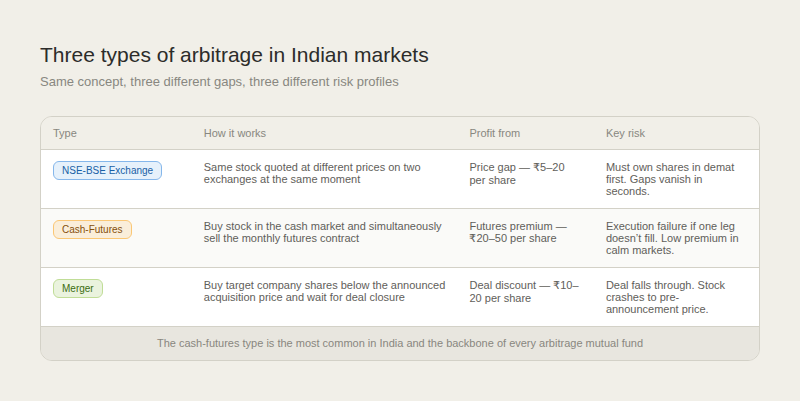
Here is a real example. Kirloskar Industries was once quoted at Rs 546 on BSE and Rs 562 on NSE at the same moment. A trader who owned the shares could sell them on NSE at Rs 562 and simultaneously buy them back on BSE at Rs 546. That is a Rs 16 profit per share, completely locked in.
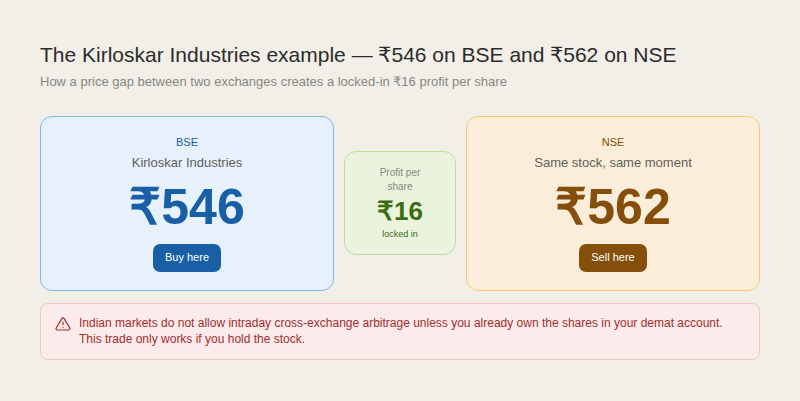
One important rule in India. You cannot buy shares on NSE and sell them on BSE on the same day unless you already own those shares in your demat account. The Indian market does not allow intraday buy-and-sell across exchanges. So the classic NSE-BSE arbitrage only works if you already hold the stock.
The cash-futures arbitrage: the most common type in India
This is where most professional arbitrage in India actually happens. And it is slightly different from the exchange arbitrage above.
Every stock that has futures contracts on NSE has two prices at any given moment. The cash price, which is what you pay to buy the share right now. And the futures price, which is what the market expects the share to be worth at the end of the month.
Futures almost always trade at a premium above the cash price. If a stock is at Rs 1,000 in the cash market and its monthly futures contract is at Rs 1,040, that Rs 40 difference is the spread.
An arbitrageur buys the stock in the cash market at Rs 1,000 and simultaneously sells the futures at Rs 1,040. At expiry, both prices converge. The profit of Rs 40 per share is locked in from day one, regardless of which direction the stock actually moves.
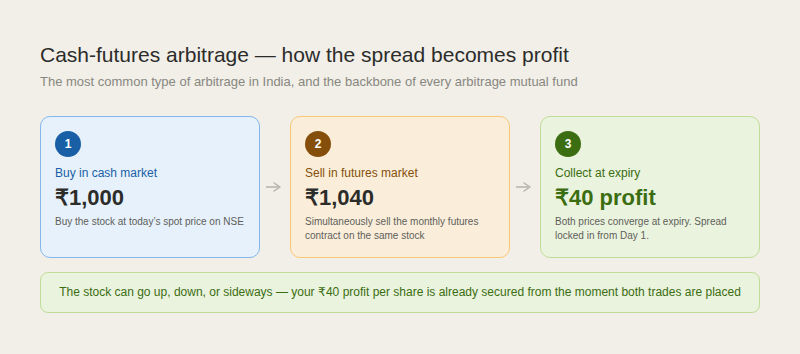
This strategy is the backbone of arbitrage mutual funds in India.
What is a merger arbitrage?
This is a third type that is slightly more interesting. When Company A announces it will buy Company B at a certain price, Company B’s share price jumps closer to the offer price but usually not all the way there.
Why? Because there is always some uncertainty. What if the deal does not close? What if SEBI or the Competition Commission blocks it? The market prices in that uncertainty by keeping a small gap.
If Company B is trading at Rs 90 and the acquisition offer is Rs 105, a merger arbitrageur buys at Rs 90 and waits for the deal to close at Rs 105. The profit is Rs 15. But the risk is real. If the deal falls through, the stock can fall sharply back to where it was before the announcement.
Arbitrage mutual funds: the easiest way to benefit
Most retail investors in India cannot monitor price gaps in real time or execute both legs of a trade in milliseconds. That is the job of machines and professional traders.
But here is the good news. You can benefit from arbitrage returns without doing any of this yourself through arbitrage mutual funds.
These funds do all the work for you. They buy stocks in the cash market and simultaneously sell futures on the same stocks. They capture the spread as their return. Because the trades are hedged, the portfolio barely moves even when markets crash.
The entire category has grown dramatically. By November 2025, the total AUM of arbitrage mutual funds in India had crossed Rs 2.75 lakh crore, growing nearly 40 percent in a single year. Monthly inflows of over Rs 4,000 crore show just how popular they have become.
The tax advantage that makes them special
Here is where arbitrage funds become really attractive, especially for investors in higher tax brackets.
Despite being a conservative, near-zero-risk product, arbitrage funds are classified as equity funds for tax purposes by SEBI. Why? Because they always maintain at least 65 percent of their portfolio in equity and equity derivatives.
This means if you hold your investment for more than one year, gains up to Rs 1.25 lakh per financial year are completely tax-free. Beyond that, only 12.5 percent long-term capital gains tax applies.
Compare this to a fixed deposit, where every rupee of interest is taxed at your personal income slab rate. If you are in the 30 percent tax bracket, a 7 percent FD actually gives you only about 4.9 percent after tax. An arbitrage fund giving similar gross returns could give you significantly more after tax.
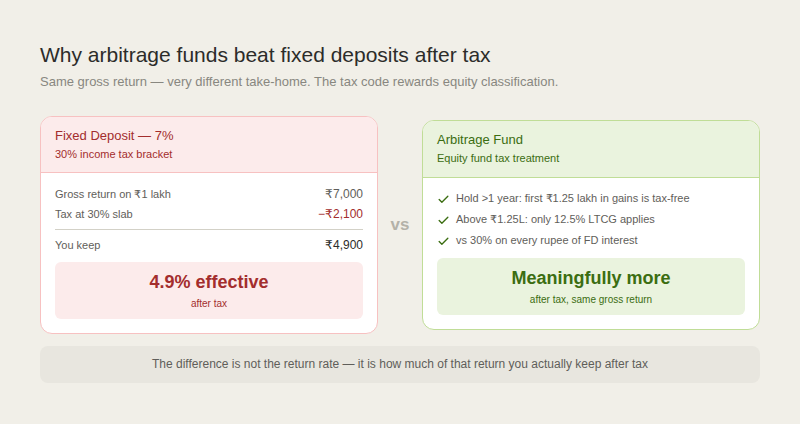
This tax efficiency is the single biggest reason for the explosive growth of arbitrage funds among Indian investors looking for a low-risk, short-term parking option.
The real risks you must understand
Arbitrage is often described as risk-free. That is not entirely accurate.
The biggest risk in direct arbitrage is execution risk. You place the buy order on BSE and the sell order on NSE simultaneously. But what if one side fills and the other does not? You are now holding an open position with directional risk, which is exactly what you were trying to avoid.
In NSE-BSE arbitrage, the opportunity window is tiny. Algorithms run by large institutions close these gaps within fractions of a second. A human trader sitting at a laptop simply cannot compete with these machines for the fastest opportunities.
Transaction costs are another silent killer. Every arbitrage trade involves brokerage, Securities Transaction Tax, GST, and stamp duty. A Rs 2 gap on a stock sounds like profit. But after all costs, you might actually lose money on that specific trade.
For arbitrage mutual funds, the risk is that when volatility is low and futures premiums shrink, the fund has fewer opportunities. During such periods, fund managers park some capital in short-term debt instruments, which earns lower returns.
Who should use arbitrage and who should not?
Direct arbitrage trading, where you yourself identify and execute the trades, is best suited for professional traders with fast execution systems, large capital, and low transaction costs. It is not for beginners or small investors doing it manually.
Arbitrage mutual funds, on the other hand, are suitable for almost any investor looking for a low-risk place to park money for three months to one year. The returns are modest but predictable. The risk of loss is very low. And the tax treatment is far better than any fixed income alternative.
They are not meant for long-term wealth creation. They are a smart tool for short-term capital parking with tax efficiency built in.
If your goal is long-term wealth creation rather than short-term cash parking, working with a SEBI registered stock advisory can provide disciplined, research-backed investment recommendations within a regulated framework.
One simple closing thought
Arbitrage is beautiful in its logic. The same thing cannot permanently have two prices in an efficient market. The moment a gap appears, money rushes in to close it.
For retail investors, the most practical way to benefit from this is through arbitrage mutual funds. You get professional execution, a diversified book of trades, and equity tax treatment on what is essentially a near risk-free strategy.
It is not the most exciting investment. But in the right situation, it can be one of the most sensible ones.