You have probably noticed it.
Gold moves slowly. Steadily. Like a large ship turning in the ocean.
Silver moves like a speedboat in a storm.
One week it is up 15%. The next it is down 20%. Then it bounces 30% before you have had time to think.
Both are precious metals. Both are traded on MCX. Both move when global uncertainty rises.
So why does silver behave so differently?
The answer is not complicated. But most investors, and even those following informal short term trade advice, never get a clear explanation.
Here it is.
First, what does volatility mean?
Volatility just means how much a price goes up and down.
Over 60 years of data, gold’s average annual price swing is 16.2%. Silver’s is 28.8%. That is almost double.
Gold has been more volatile than silver less than 9% of the time since 1968.
Silver even has a nickname because of this. Traders call it the Devil’s Metal.
Now here is why.
Reason 1: Silver’s market is tiny
Think of a large lake and a small pond.
Throw a big rock into the lake. The water barely ripples. Throw the same rock into the pond. Waves everywhere.
The silver market is roughly one-tenth the size of the gold market by value. The same money that barely moves gold can send silver flying in either direction.
This is why silver’s rallies have been roughly twice the size of gold’s on average. And why its crashes are twice as sharp.
Reason 2: Silver is two things at once
Gold is bought mostly as a safe haven. Industrial use is only about 7.5% of total demand.
Silver is completely different. Over 59% of silver demand is industrial. That is the highest ever recorded.
Silver is inside your smartphone, your electric vehicle, every solar panel on Indian rooftops, 5G towers, and AI components.
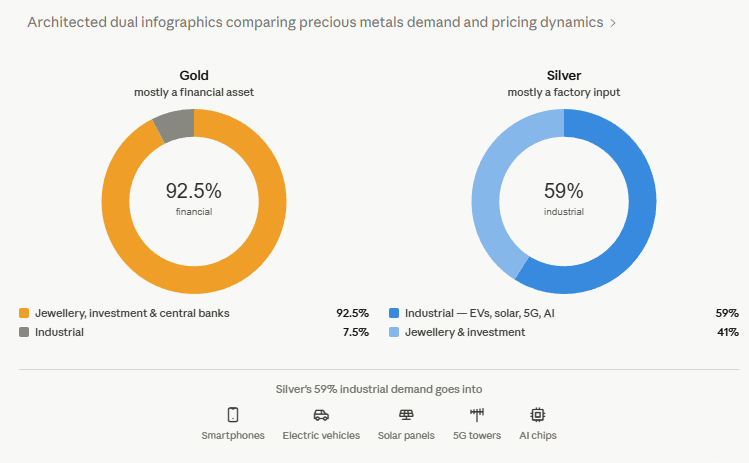
When the economy grows, factories need more silver and investors want it as a store of value. Both forces push the price up together. When the economy slows, both forces push it down together. That is why the swings are bigger every single time.
Reason 3: Silver attracts more speculators
Gold at over Rs.14,000 per gram is out of reach for many first-time investors.
Silver at around Rs.260 per gram is not.
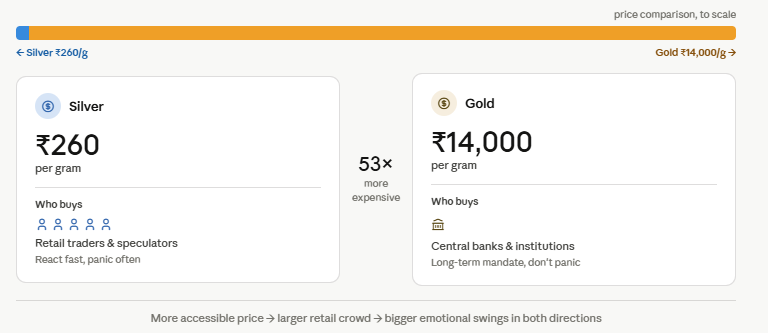
This lower price attracts a much larger crowd of retail traders and speculative capital. Speculators amplify every move. When silver rises, FOMO pulls in more buyers. When it falls, panic selling takes it lower than it should.
Gold is dominated by central banks and large institutions with long-term mandates. They do not panic. Silver’s crowd does.
Reason 4: Silver supply cannot keep up
About 70 to 75% of silver produced globally is a byproduct of mining copper, lead, and zinc. Not from dedicated silver mines.
Even if silver prices double, supply cannot suddenly jump. Global mine production peaked in 2016 and has declined 7% since, even as demand kept rising.
Silver has been in a supply deficit every single year from 2021 to 2025. The total shortfall over that period is around 800 million ounces. Roughly one full year of global mine production. When demand grows and supply cannot respond, prices do not move gently. They spike.
Reason 5: Silver is harder to trade in large amounts
Gold is one of the most liquid assets in the world. Central banks trade it in enormous quantities every day.
The silver market is far thinner. When a large investor wants to buy silver quickly, the market has to move sharply to find willing sellers. On MCX, silver can gap up or down several percent between sessions. For leveraged traders, this creates serious risk.
This is why experienced participants rely on structured strategies or a SEBI registered stock advisory instead of trading purely on instinct.
Reason 6: No central bank buys silver
In 2024, central banks globally bought over 1,000 tonnes of gold. These buyers are not sensitive to short-term price changes. They buy because of long-term policy. This creates a steady floor under gold’s price.
No central bank holds silver. None.
When silver falls, there is no institutional cushion sitting underneath it. It keeps falling until retail traders decide to step in. A 2025 survey found that 95% of central banks expect global gold reserves to rise in 2026. That tailwind simply does not exist for silver.
The comparison at a glance
| Metric | Gold | Silver |
|---|---|---|
| Avg annual volatility | 16.2% | 28.8% |
| Market size | Very large | About 1/10th of gold |
| Industrial demand | 7.5% of total | 59% of total |
| Central bank buyers | Yes, 1,000+ tonnes/year | None |
| 10%+ quarterly drops in 40 years | 4 times | 18 times |
What happened in 2025
Silver surged to a record of $54.47 per ounce in October 2025. Safe-haven buying and record industrial demand kicked in at the same time.
Then came the reversal. When the US exchange raised margin requirements and the dollar strengthened, silver fell roughly 44% from its January 2026 peak. Gold corrected far more calmly in the same period.
Silver’s volatility rose 106% year to date in early 2026, versus 46% for gold.
The Devil’s Metal lived up to its name.
How to invest in silver in India
As of April 2026, silver is around Rs.2,44,900 per kilogram on the spot market. Indian investors also pay 10.75% import duty and 3% GST, and dollar-rupee movements add another layer of volatility on top of global price swings.
Your main options:
Physical silver from BIS-hallmarked sources, banks, or MMTC-PAMP. Has storage costs and attracts 3% GST.
Silver ETFs on NSE like SILVERBEES, which hold physical silver in vaults and trade like stocks through any demat account. The simplest option for most investors.
Silver Mutual Funds that invest in Silver ETFs. Good for SIP-based investors.
MCX Futures for experienced traders only. Margin requirements can change during volatile periods and can force liquidations at a loss.
Is silver right for you?
Silver may suit you if you can handle a 20 to 30% drawdown without panic-selling, have a five-year-plus time horizon, already hold gold and want higher upside exposure, or are an experienced MCX trader with proper risk controls.
Silver is probably not for you if you need stable returns, are investing money you cannot afford to see fall 40%, or are new to commodity markets.
Most experienced advisers suggest treating gold as the core precious metals holding and silver as a smaller satellite position, around 25 to 30% of your total precious metals allocation.
Conclusion: Two metals, two very different jobs
Gold is the anchor. It moves slowly, holds value across decades, and has the backing of central banks worldwide. It is the foundation every serious investor should have before anything else.
Silver is the engine. It moves fast, carries the added fuel of industrial demand from solar energy, electric vehicles, and AI hardware, and can surge dramatically when conditions align.
But that engine can backfire.
Silver has fallen 44% in months. It has punished traders who entered with too much leverage and too little patience.
Understanding the six reasons in this article puts you in a fundamentally different position from the investor who buys silver on a WhatsApp tip and cannot understand why the price suddenly drops 20% the following week.
Know what you own. Size it correctly. Give it time.
The Devil’s Metal can be a very good investment for the right investor.
The question is whether that investor is you.