
Let us start with something most people have never thought about.
You already know what a demat account is. You open one, link your bank, and start buying shares or mutual funds. Done.
Whether you invest on your own or follow the best stock advisor in India for research and investment ideas, understanding how you hold your investments is just as important as deciding which stocks to buy. The type of demat account you choose can affect taxation, ownership, and long-term wealth creation.
But here is what most Indian families do not know. There is a second type of demat account that the law allows. One that can legally reduce your family’s total tax bill every year. One that keeps family money separate from personal money. And one that helps you plan wealth for the next generation.
It is called a HUF demat account.
Most families have never heard of it. The ones that have are quietly saving thousands of rupees in tax every year. Let us understand exactly how.
What is an individual demat account?
This is the one you probably already have.
You open it in your own name. You run it yourself. You decide what to buy and sell. Nobody else has any say. All the profits and dividends land in your account and get taxed as your personal income.
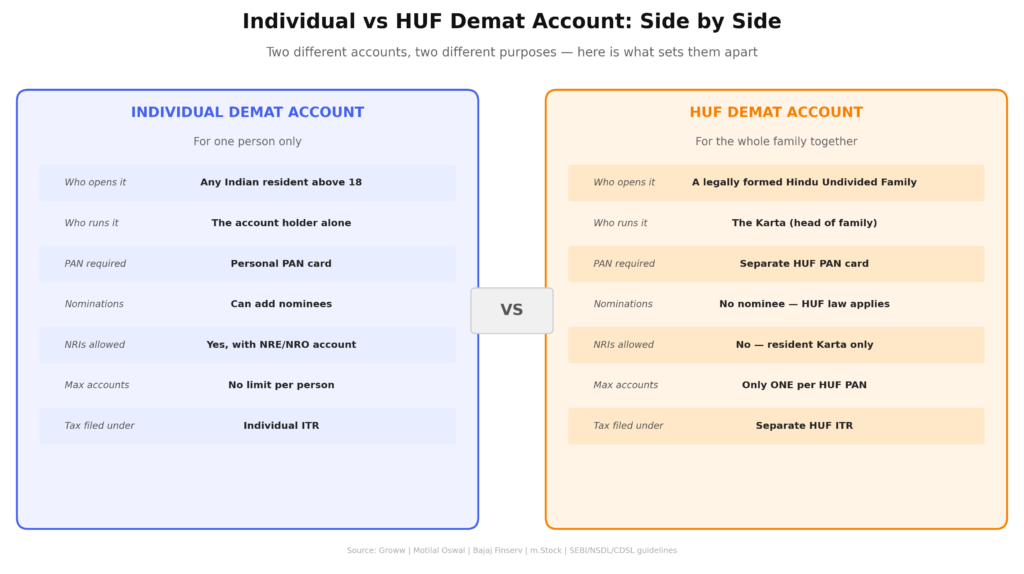
Anyone above 18 with a PAN card can open one. It takes about ten minutes online. You can add a nominee so your investments pass to your family easily. You can have as many individual demat accounts as you want.
Simple, clean, and completely yours.
What is a HUF demat account?
HUF stands for Hindu Undivided Family.
Under Indian law, a HUF is not just a family. It is treated as a completely separate entity, almost like a small company. It gets its own PAN card. It files its own income tax return. It can hold investments in its own name.
A HUF demat account is opened in the family’s name, not in anyone’s personal name. The person who manages it is called the Karta. That is the head of the family. Usually the eldest member. The Karta takes all the investment decisions on behalf of the entire family.
All family members are considered joint owners of everything inside this account. But only the Karta signs and manages it day to day.
Hindu, Jain, Sikh, and Buddhist families can form a HUF. NRIs cannot open or operate a HUF demat account.
Now the part that really matters. The tax benefit.
This is where most people’s eyes light up. Let us break it down in the simplest possible way.
Imagine your family as two separate taxpayers.
Right now, your income and your investment profits go into one bucket. Your personal PAN. You pay tax on everything together.
A HUF gives your family a second bucket. A completely separate one with its own PAN. Now your investment income can be split across two buckets instead of one.
Here is why that matters.
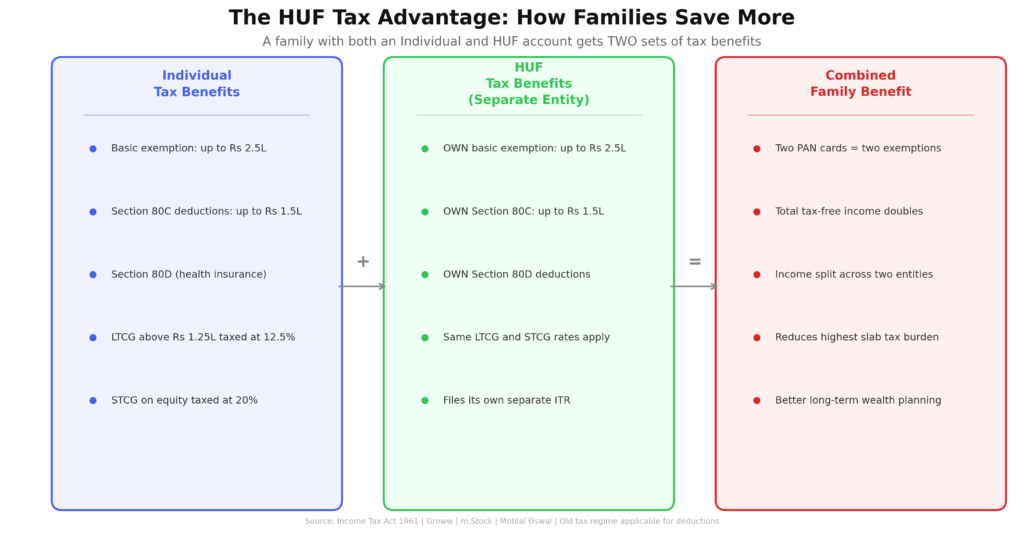
Under the old tax regime, every taxpayer gets a basic exemption of Rs 2.5 lakh. That means the first Rs 2.5 lakh you earn is completely tax-free.
When you have a HUF, you get this exemption twice.
You get Rs 2.5 lakh tax-free personally. And the HUF gets another Rs 2.5 lakh tax-free separately. That is Rs 5 lakh of tax-free income for your family, simply by using both accounts.
It does not stop there.
Under Section 80C of the Income Tax Act, every taxpayer can invest up to Rs 1.5 lakh in options like PPF, ELSS, or life insurance and get a tax deduction on that amount. This means Rs 1.5 lakh is deducted from your taxable income before tax is calculated.
With a HUF, you get this benefit twice also. Rs 1.5 lakh in your personal name. Another Rs 1.5 lakh in the HUF’s name. That is Rs 3 lakh in total 80C deductions instead of Rs 1.5 lakh.
The same applies to Section 80D, which covers health insurance premiums. The HUF can separately claim deductions on insurance for family members.
One important thing to note. These deduction benefits only apply under the old tax regime. The new tax regime is now the default for both individuals and HUFs from 2024-25 onwards. If you want to use these deductions, you need to specifically choose the old regime when filing your HUF’s tax return.
What about capital gains tax?
Both accounts follow the same rules. If you sell shares held for less than one year, you pay 20 percent tax on profits. If held for more than one year, you pay 12.5 percent on gains above Rs 1.25 lakh.
But here is the smart part. If your combined family gains are large, splitting them between your personal account and the HUF account means each entity might stay below the Rs 1.25 lakh LTCG exemption limit. That means less tax, or in some cases no tax at all on long-term gains.
The differences you need to know before choosing
Nominations. An individual account lets you add a nominee, so your investments transfer smoothly to a family member after you. A HUF account has no nominee facility at all. When the Karta passes away, the succession follows HUF law and a legal process decides what happens next. This needs careful planning.
NRIs. If you live abroad, you can open an individual demat account using an NRE or NRO account. But you cannot open or operate a HUF demat account. The Karta must be a resident Indian at all times.
Number of accounts. You can have multiple individual demat accounts. But a HUF can open only one demat account against its PAN. However, every individual family member can still have their own separate personal account in addition to the HUF account.
Decision making. In your individual account, you are the boss. In a HUF account, the Karta manages everything, but for major decisions involving large assets, the consent of other family members may sometimes be needed. This can slow things down slightly.
Time to open. An individual account takes about ten minutes online. A HUF account takes two to seven days because it involves more documents and verification.
How to actually open a HUF demat account
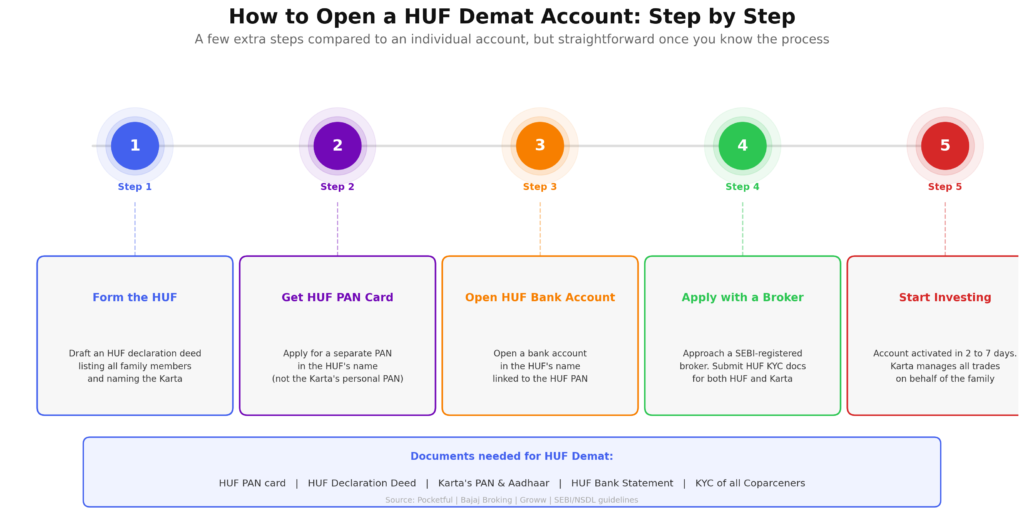
The process has five steps.
First, the family drafts an HUF declaration deed, a simple document listing all family members and naming the Karta. Second, apply for a separate PAN card in the HUF’s name. This is different from the Karta’s personal PAN. Third, open a bank account in the HUF’s name using that PAN. Fourth, go to any SEBI-registered broker and submit KYC documents for both the HUF and the Karta. Fifth, once verified, the account is ready and the Karta can start investing.
So which one should you choose?
If you are a salaried person investing for your own retirement or goals, an individual demat account is all you need. It is simple, fast, and gives you complete control.
If your family has pooled savings, ancestral property, rental income, or any income that genuinely belongs to the family as a whole, a HUF account makes real sense. The tax savings alone can be worth the extra paperwork.
The best move for most families with reasonable investments is to have both. Your personal account for individual goals. The HUF account for family wealth. Two buckets, two sets of tax benefits, cleaner money management.
Before setting up a HUF, a quick conversation with a tax advisor is always a smart first step. Every family’s situation is different and the rules have specific nuances around how money enters the HUF.
While this article focuses on investment structure rather than trading strategies, choosing the right account is equally important for long-term investors and those who regularly follow Swing stock trading tips in India. A well-planned account structure can make managing profits, taxes, and family wealth much more efficient over time.
One last thought
The Indian government has given families a powerful and perfectly legal tool to save tax and build wealth more efficiently. It has existed for decades. Yet most families never use it simply because nobody explained it clearly.
Now you know what it is, how it works, and how the tax saving actually happens.
The next step is yours.