In January 2009, one letter wiped out most of a company’s stock value in a matter of days. The company was Satyam Computer Services, once one of India’s biggest IT firms. People still call it India’s Enron. Here’s the simple version of what happened, and why it still matters.
For investors looking for a SEBI registered investment advisor, understanding cases like Satyam is important because investment decisions should be based not only on stock-price movements, but also on the quality and reliability of a company’s financial information.
What Was Satyam, Really?
Satyam Computer Services was a major Indian IT company. It was founded by B. Ramalinga Raju and listed on the Bombay Stock Exchange in 1991. By 2008, it was India’s fourth largest IT services company, with over 50,000 employees and clients around the world.
On paper, it looked like a huge success story.
How the Fraud Started and Grew
For years, Raju had been secretly inflating Satyam’s numbers. He made the company’s profits and cash balances look much bigger than they actually were.
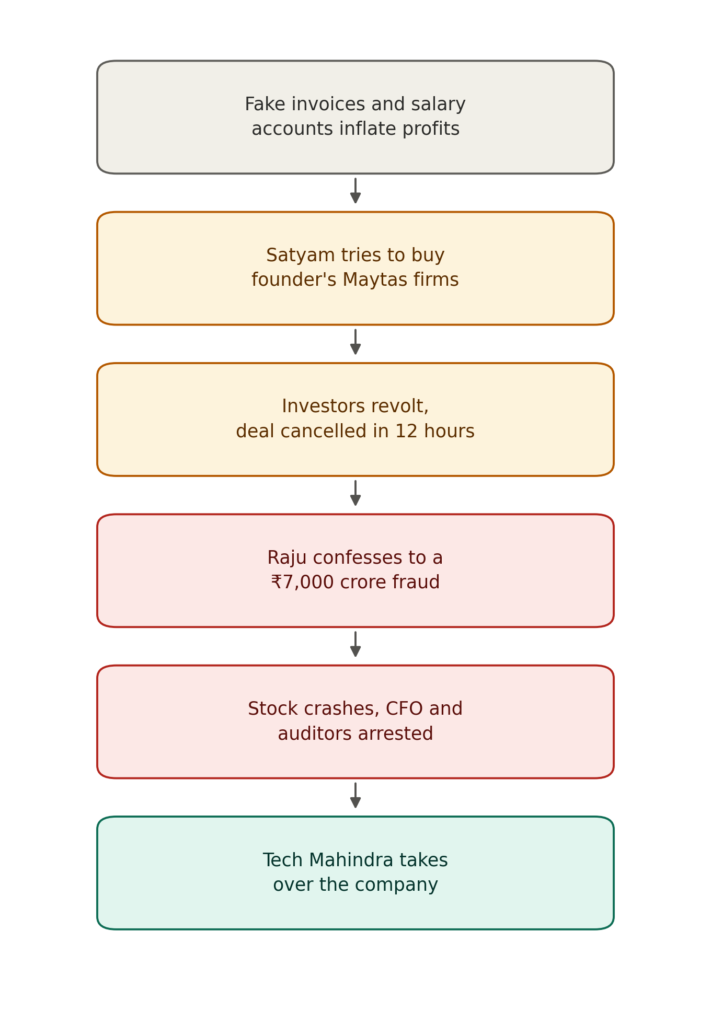
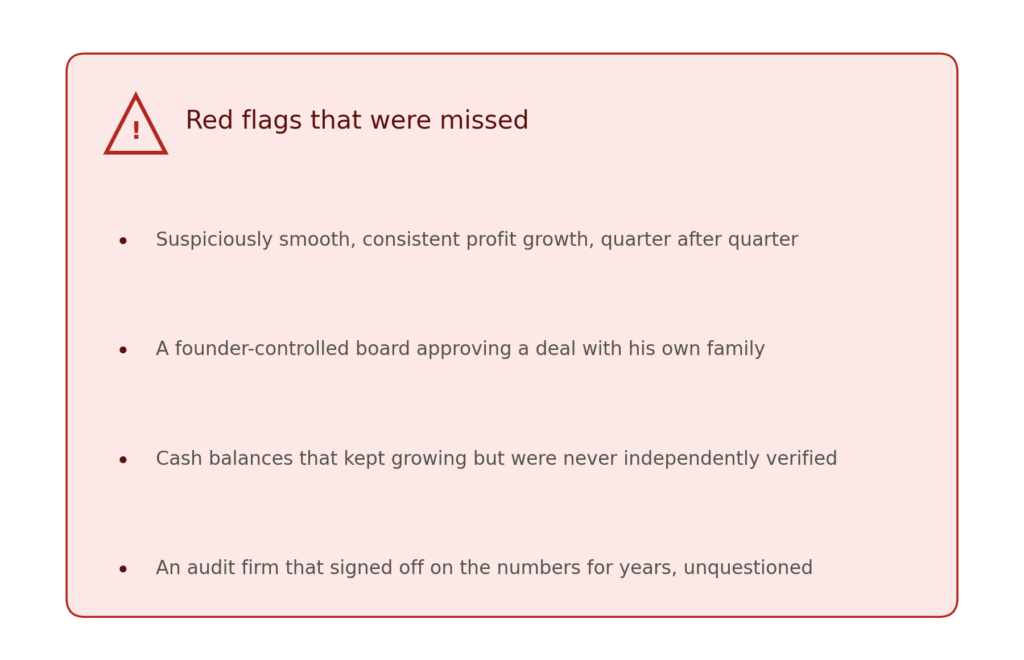
How did he pull this off? The company created fake customer invoices to show revenue that never really came in. It also set up around 6,000 fake employee salary accounts, used to quietly move money out of the business. On paper, Satyam looked cash-rich and highly profitable. In reality, a large piece of that was fiction.
This fake success helped Satyam borrow money easily and kept its share price climbing, since investors trusted numbers that weren’t true.
The Maytas Deal That Blew the Lid Off
In December 2008, Satyam’s board announced a plan to buy two real estate companies, Maytas Properties and Maytas Infra. Both were owned by Raju’s own family.
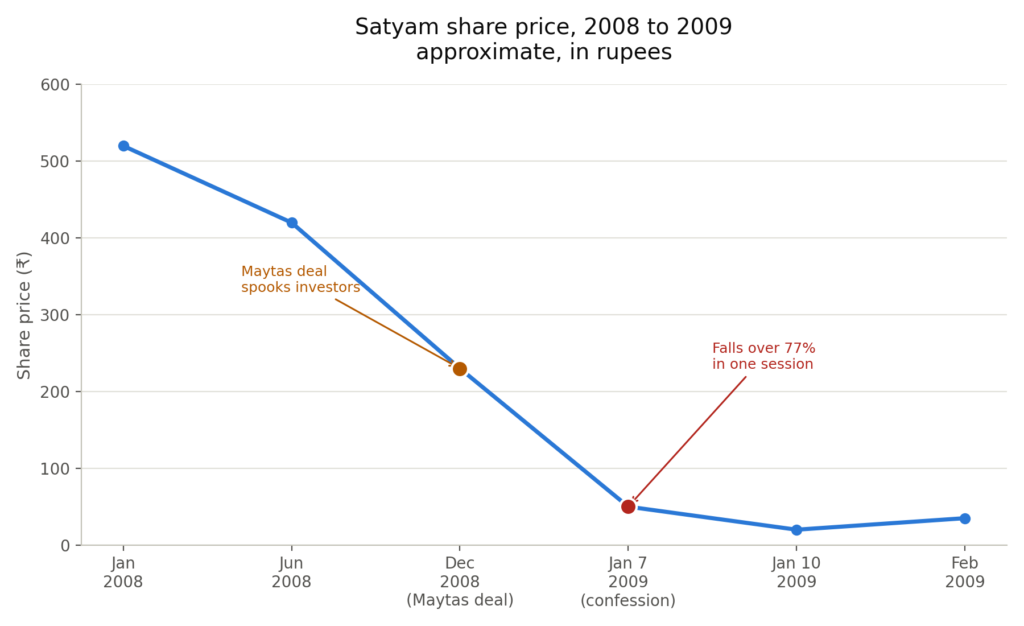
Investors were furious. It looked like Satyam’s cash was being used to bail out the founder’s personal businesses, not to help Satyam itself. The backlash was so strong that the deal was cancelled within about 12 hours. But the damage was done. The stock price took a serious hit, and people started asking harder questions.
The Confession That Shook India
On January 7, 2009, Raju sent a letter to Satyam’s board and to SEBI, India’s market regulator. In it, he admitted the truth.
He confessed to inflating the company’s accounts by roughly ₹7,000 crore. Cash balances that didn’t exist. Profits that had never been earned. Years of fabricated numbers, all coming undone in a single letter.
He even described the failed Maytas deal as a last, desperate attempt to plug the hole with something real.
What Happened to the Stock
The market reaction was brutal. Satyam’s share price, which had traded above ₹500 in early 2008, had already been sliding due to the Maytas controversy. After Raju’s confession, it collapsed by more than 77% in a single trading session, eventually falling to around ₹20.
Shareholders, many of them ordinary retail investors, watched a large chunk of their savings disappear within days.
The Aftermath
The fallout moved fast. Satyam’s CFO was arrested just three days after the confession. Later that month, the company’s external auditors from PwC’s Indian arm were arrested too, accused of missing, or ignoring, years of fabricated numbers.
The Indian government stepped in and appointed a new board of respected business leaders to stabilize the company and run a transparent sale process. By April 2009, Tech Mahindra won that process and took over Satyam. The company was eventually renamed and fully merged into Tech Mahindra a few years later.
Raju and several others were formally convicted years later for their role in the fraud.
Why This Still Matters
The Satyam scandal became a turning point for corporate governance in India. It led to stricter rules around auditor accountability, independent directors, and financial disclosures, changes that still shape how Indian companies are regulated today.
It’s also a reminder that a company’s stock price and its actual numbers can drift apart. For years, that gap can be hidden. It can’t stay hidden forever.
Lessons for Investors
- A company that looks “too smooth,” with suspiciously consistent profits and little volatility, is worth a closer look, not automatic trust.
- Related-party deals, like a company buying assets from its own founder’s family, deserve extra scrutiny.
- Auditors are supposed to be a safety net, but they aren’t infallible. Don’t treat a clean audit report as absolute proof of a healthy company.
- Diversifying across companies and sectors limits how much damage one single fraud can do to your overall portfolio.
These lessons matter beyond long-term investing. Even investors seeking Swing trading advice should understand the underlying business and major corporate risks before taking a position. A strong chart setup cannot remove the risk created by unreliable financial information.
Conclusion
Satyam’s downfall didn’t happen because the business plan failed. It happened because the numbers behind the business were never real to begin with.
A balance sheet is supposed to tell the truth about a company. When it doesn’t, the first people to find out are rarely the investors, and by the time they do, the damage is already done.