Have you noticed that when the Sensex and Nifty are climbing, the IPO calendar gets crowded, with a new issue opening every other week? And when markets turn choppy, the calendar goes quiet?
That’s not a coincidence. There are clear reasons, and understanding them can make you a smarter IPO investor.
Understanding market cycles is important not just for IPO investors but for anyone participating in the stock market. Whether you are evaluating a new public issue or tracking listed companies, research-backed decisions matter. A SEBI registered stock advisory can help investors understand market trends, assess opportunities, and approach the market with greater discipline.
First, a Quick Refresher
An IPO, or initial public offering, is when a private company sells its shares to the public for the first time and lists on the NSE and BSE.
Most IPOs have two parts. A fresh issue is when the company raises new money. An offer for sale, or OFS, is when existing shareholders, such as founders and private equity funds, sell some of their own shares. In India, the fresh issue has made up only about 35% to 40% of total IPO funds raised since 2021, which means the rest largely comes from existing shareholders selling.
So the big question for every company and its backers is simple: when is the best time to sell? Usually, the answer is when the market is strong.
Reason One: A Better Price
Think about selling a house. You’d rather sell in a hot property market, when buyers compete, than in a slump. Companies think the same way.
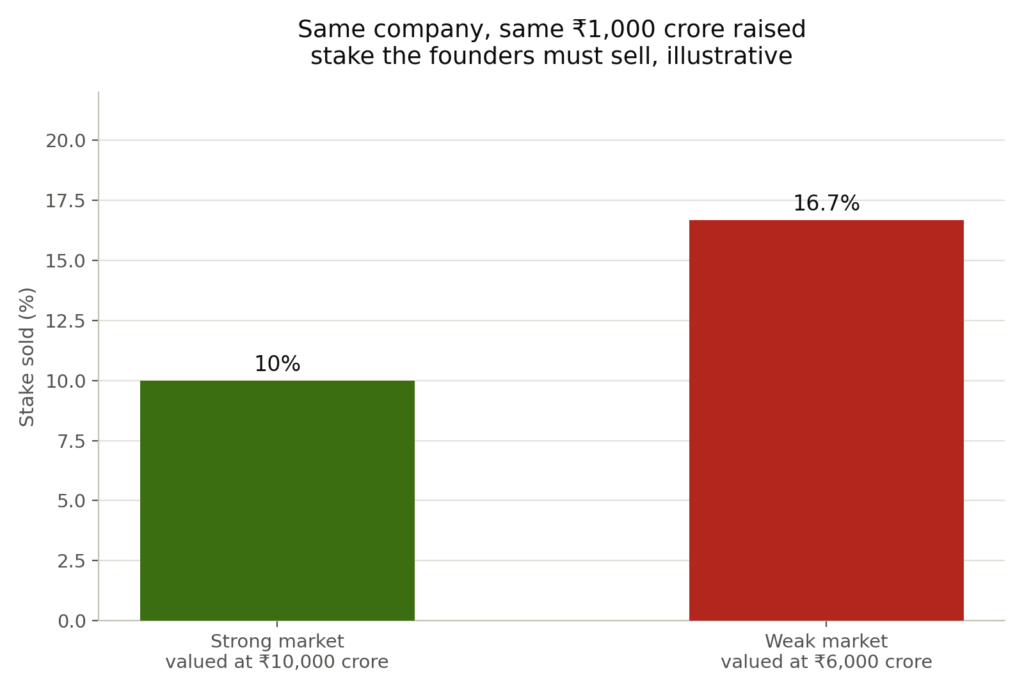
Say a company wants to raise ₹1,000 crore. Here’s what happens in two different markets.
In a strong market, the founders give up a much smaller slice for the same money. And any shareholders selling through an OFS get a better price for their shares too.
Reason Two: Hungry Buyers
Rising markets make investors confident, and often richer. People who have made gains are more willing to try new investments.
That means an IPO is easier to sell. According to KPMG, in FY25 the average oversubscription was about 102 times for qualified institutional buyers and 35 times for retail investors. In other words, there were many times more orders than shares available.
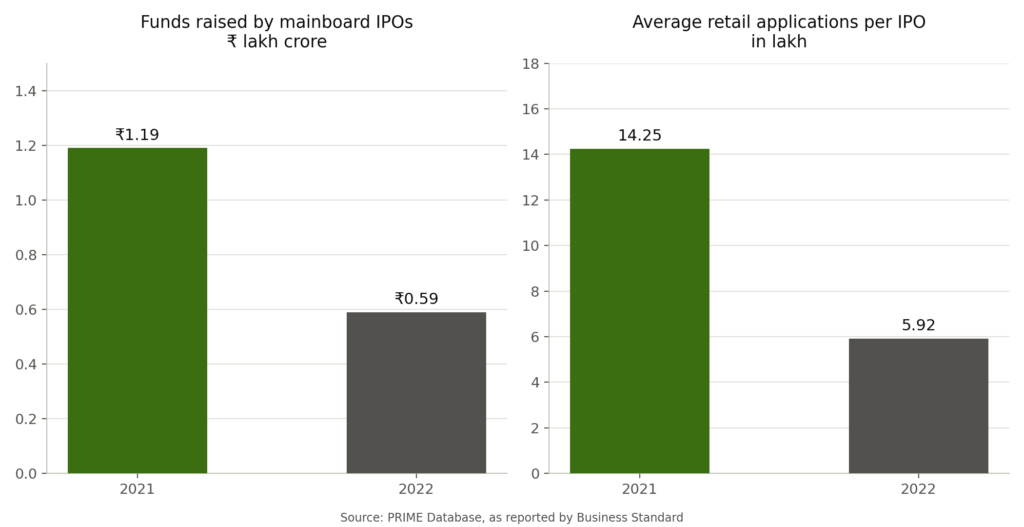
Retail interest also follows market mood. PRIME Database data shows the average IPO drew about 14.25 lakh retail applications in 2021. In 2022, when the IPO market cooled, that fell to about 5.92 lakh.
Reason Three: An Easier Story
Every IPO comes with a story about why the company is worth its price. In a bull market, similar listed companies often trade at high valuations. That gives the new company a strong benchmark to point to.
In a falling market, the same story is a harder sell. Investors ask tougher questions and offer lower prices.
Reason Four: Early Investors Want an Exit
Private equity and venture capital funds don’t invest forever. They want to sell, ideally at a strong price. A bull market gives them their best chance, and the OFS portion of an IPO is how many of them cash out.
Reason Five: Timing and the “Window”
An IPO takes months to prepare. A company files its draft offer document with SEBI, waits for approval, and then generally has about a year to launch. So companies and their bankers wait for an open window, a stretch when conditions favor new listings.
If sentiment sours, issues get delayed. KPMG notes that in the last quarter of FY25, foreign portfolio investors kept selling Indian equities, and IPO activity was subdued, with only 11 IPOs in that quarter.
Reason Six: The Feedback Loop
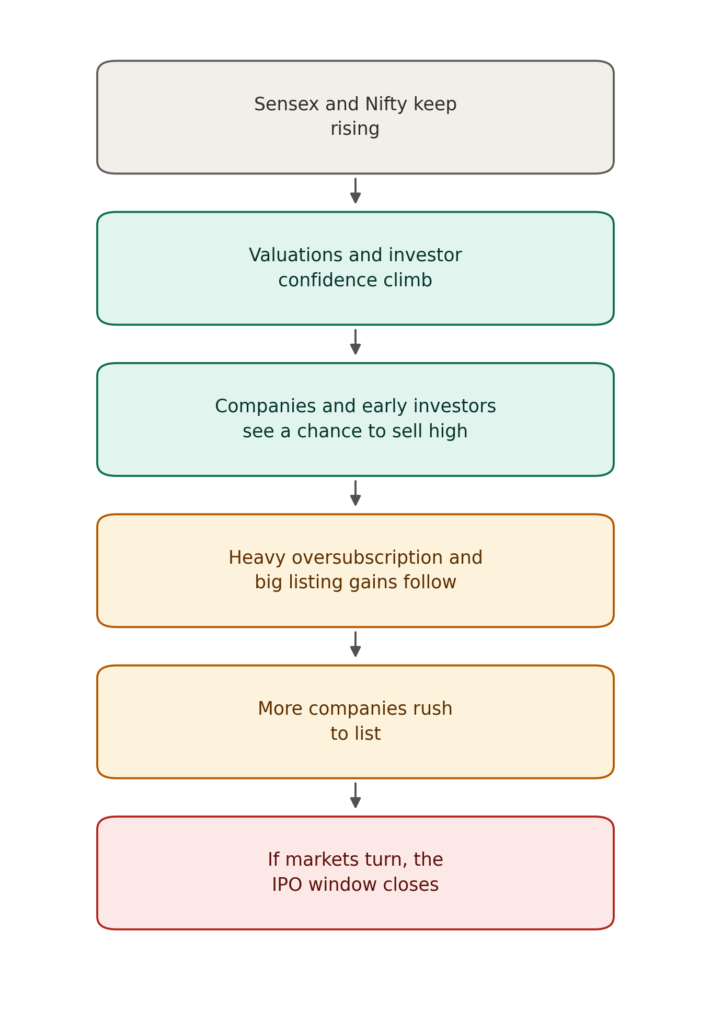
Success breeds more of the same. Strong listing gains attract more companies. More IPOs bring in more eager buyers. Grey market chatter heats up, fear of missing out spreads, and the cycle feeds itself until markets cool.
What the Numbers Show
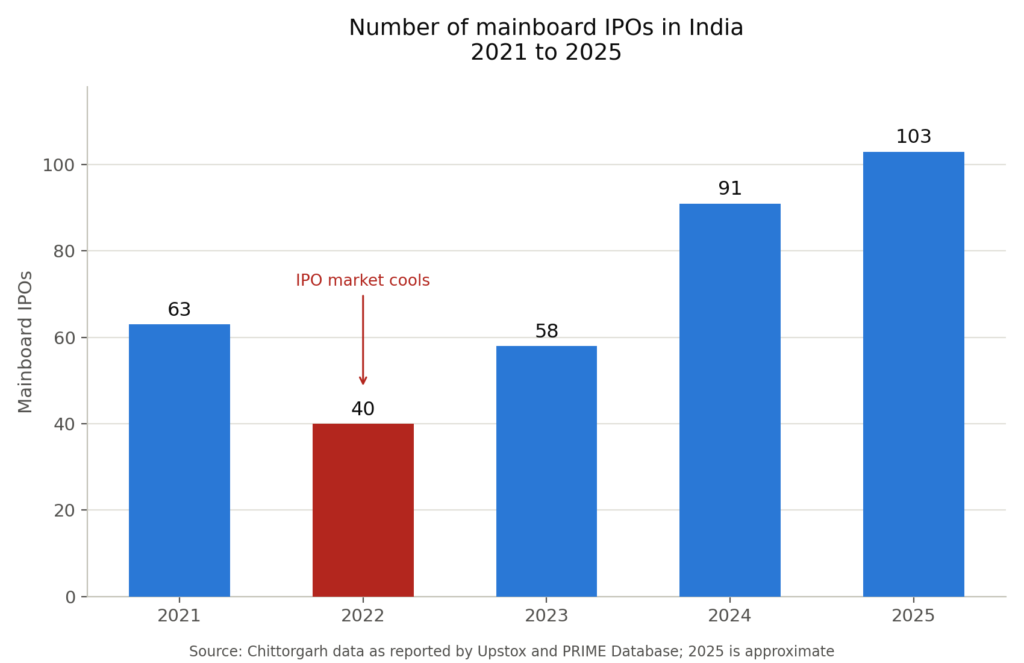
Indian IPO data tells the story clearly. According to PRIME Database, 63 companies raised a record ₹1.19 lakh crore through mainboard IPOs in 2021. In 2022, the number fell to 40, and the money raised roughly halved to about ₹59,000 crore. Even that was propped up by LIC’s mega IPO, which alone raised ₹20,557 crore, or about 35% of the year’s total.
Then the window reopened. Chittorgarh data reported by Upstox shows mainboard IPOs climbing from 58 in 2023 to 91 in 2024, and about 103 in 2025.
The Catch for Investors
Companies pick the moment that suits them best, and that’s often when prices are high. A busy IPO calendar doesn’t guarantee gains for you.
A review of 2025 IPOs by IndMoney found that the median listing gain fell to 3.8% from 15.2% in 2024, and that about 59% of that year’s IPOs were trading below their listing price at the time of the review. Plenty of supply and strong subscriptions didn’t stop that.
- A listing gain isn’t a long-term return. Shares that jump on day one can still fall later.
- Read the offer document. Check profits, debt, and how the valuation compares with similar listed companies.
- Look at the fresh issue versus OFS split. If most of the money goes to existing shareholders cashing out, ask why.
- Treat subscription numbers and grey market chatter as mood, not proof. They show enthusiasm, not whether a business is worth the price.
IPO investing is just one way to participate in the stock market. Investors who prefer a more active approach can also explore a short term trading opportunity in listed stocks, where market trends, technical analysis, and price movements help identify potential entry and exit points. However, these opportunities require a separate strategy and disciplined risk management.
Conclusion
Farmers sell their harvest when market prices are best. Companies sell their shares the same way. They go public when buyers are generous and prices are high.
That’s good for the company and its early backers. For you, it’s a reminder to ask one question before you apply to any IPO: is this a good business at a fair price, or just a good moment to sell?