You’re scrolling through the news before an IPO opens, and you see a line like “Alpha Foods IPO GMP: ₹50.” Your friends are excited. Someone says it’s “a sure listing gain.”
What is GMP, exactly? And should you trust it? Let’s break it down.
For investors exploring IPO opportunities alongside short term stock trading advisory services, understanding GMP can help put market expectations into perspective, without mistaking speculation for guaranteed returns.
What Does GMP Mean?
GMP stands for Grey Market Premium. It’s the extra amount people are willing to pay for an IPO share, above its official issue price, in an unofficial market before the share lists on the stock exchange.
Think of first-day-first-show tickets for a big film. Before release, some tickets get resold for more than their face value. That tells you people are eager. GMP works the same way. It’s a rough signal of how much demand there is for the shares.
Where Does the “Grey Market” Come From?
The grey market is an informal network of dealers and brokers. It isn’t a stock exchange. It runs on phone calls and private agreements between people, usually between the time an IPO opens and the day its shares list.
Two things are important to know:
- It’s unofficial. It isn’t recognised or regulated by SEBI or the stock exchanges.
- There’s no regulatory protection for anyone trading in it.
So GMP numbers are best read as a mood indicator. They aren’t official prices.
How to Read GMP
The math is simple. Add the GMP to the issue price to get the estimated listing price:
Estimated listing price = issue price + GMP
To see the estimated gain as a percentage, divide the GMP by the issue price.
| Scenario | Issue price | GMP | Estimated listing price | Estimated gain |
|---|---|---|---|---|
| Strong demand | ₹ 100 | ₹ 20 | ₹ 120 | 20% |
| Flat | ₹ 100 | ₹ 0 | ₹ 100 | 0% |
| Weak demand | ₹ 100 | ₹ -8 | ₹ 92 | -8% |
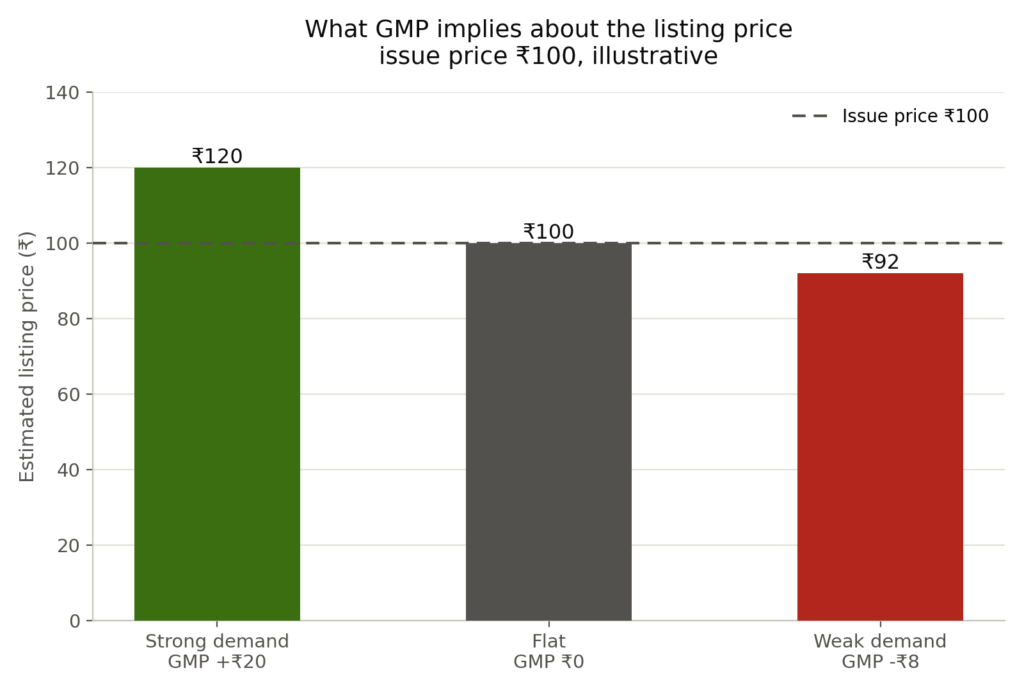
A positive GMP suggests the market expects the share to list above the issue price. A negative GMP means it may list below it.
What Moves GMP?
GMP changes from day to day. A few things push it around:
- Subscription numbers. When an IPO is heavily oversubscribed, GMP often rises.
- Market mood. A nervous stock market usually drags GMP down.
- The company and its price. Strong brands and sensible valuations tend to attract more interest.
- News and buzz. Headlines, social media talk, and the interest of big investors all play a part.
- Dealers’ own positions. People in the grey market have their own bets, which can nudge the numbers.
Why GMP Can Be Wrong
Here’s where many first-time investors get caught. GMP is not a forecast. It’s a guess.
- It’s unverified. Different websites often show different GMP numbers for the same IPO.
- It can be hyped. Talk and speculation can push a number up or down without real demand behind it.
- Things change by listing day. The stock market can move a lot between the grey market quote and the day shares actually list.
- Listing gain isn’t the whole story. Even when a share lists well, it may fall afterwards.
There have been IPOs where a high GMP didn’t turn into a strong listing, and others where a low GMP was followed by a pleasant surprise.
Three IPOs, Three Surprises
Let’s look at three fictional IPOs to see how far GMP and reality can drift apart.
| IPO | Issue price | GMP | Estimated gain | Actual listing gain |
|---|---|---|---|---|
| Alpha Foods | ₹ 200 | ₹ 50 | 25% | 8% |
| Beta Tech | ₹ 120 | ₹ 6 | 5% | 18% |
| Gamma Infra | ₹ 100 | ₹ -4 | -4% | -7% |
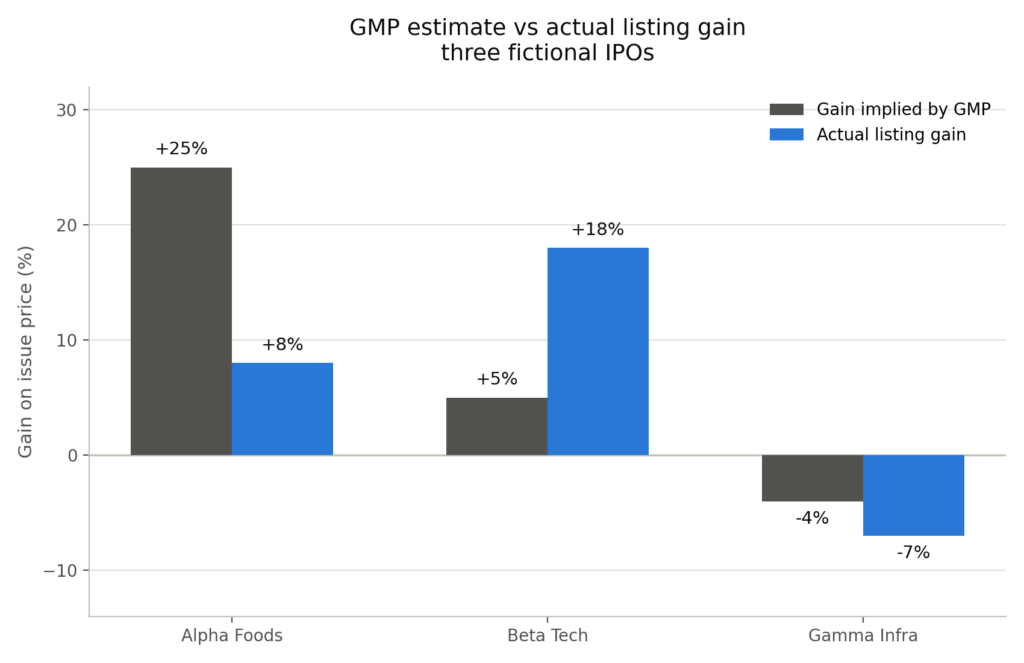
Alpha Foods looked red-hot but listed far below the grey market hint. Beta Tech looked lukewarm and then beat it. GMP pointed in the right direction for Gamma Infra, but the real number was still different.
What GMP Can’t Tell You
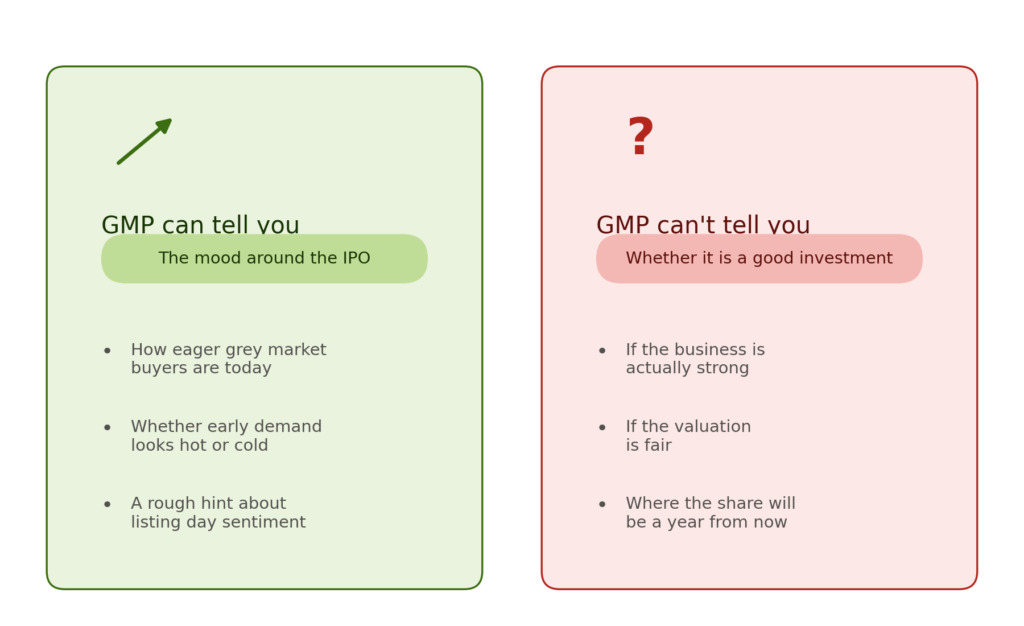
GMP says nothing about whether the company is any good. It doesn’t tell you whether the valuation is fair, how the business earns money, or where the share will be a year from now.
To learn that, you need to do the real homework:
- Read the company’s offer document, called the Red Herring Prospectus.
- Look at its profits, debt, and growth over several years.
- Compare its valuation to similar listed companies.
- Check what the IPO money will be used for.
- Look at subscription data once the issue closes.
Practical Tips for IPO Investors
- Treat GMP as one clue about market mood, never as the reason to invest.
- Don’t trade in the grey market yourself. It has no official protection.
- Decide your goal first. Are you chasing a quick listing gain, or investing in the business for years?
- Remember that allotment isn’t guaranteed, especially in popular IPOs.
- Only apply with money you can afford to leave invested if the listing disappoints.
Whether you invest independently or consult a SEBI registered investment advisor, always evaluate an IPO’s fundamentals, valuation, and risks rather than relying solely on grey market premiums.
Conclusion
GMP is like the buzz outside a theatre before a film opens. It tells you how excited the crowd is. It doesn’t tell you whether the film is any good.
Use it to understand the mood around an IPO. Then do the real work of understanding the business before you put your money in.