On September 7, 2026, a state-owned power financier called REC raised ₹500 crore through a bond sale that looked nothing like any bond sale India had seen before. No physical certificates. No days-long settlement wait. Just a bond, represented as a digital token, changing hands almost instantly. This was India’s first tokenised corporate bond, and it’s worth understanding what actually happened.
What Is a Tokenised Bond, Really?
A tokenised bond is a regular bond, still a loan you’re making to a company or government in exchange for regular interest, but its ownership record lives on a distributed ledger, a shared, digital record book, instead of only in a traditional depository system. Each token represents your slice of ownership in that bond.
Think of the difference between an old paper property deed sitting in a filing cabinet somewhere, and a constantly updated shared registry that everyone with permission can check instantly and trust, without needing a lawyer to verify the paperwork by hand.
How a Bond Normally Gets Settled
Today, when you buy a bond in India, ownership is recorded electronically through a depository like NSDL or CDSL. The money and the securities typically move through separate systems, over a settlement cycle that can take a day or more. In that gap, there’s a small window where something can go wrong, a risk known as counterparty risk.
Enter Demat 2.0 and Atomic Settlement
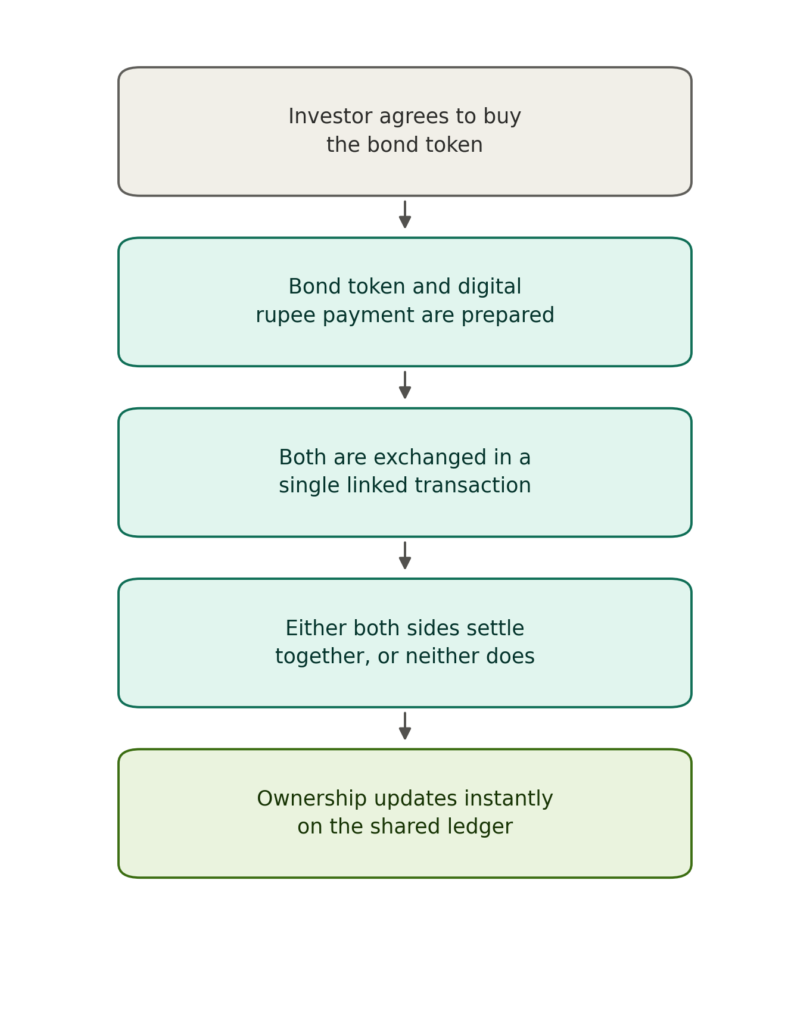
SEBI has been piloting something it calls Demat 2.0, testing whether distributed ledger technology can make bond settlement faster and safer. The REC bond issuance in September 2026 was the first live test, using DLT alongside the Reserve Bank of India’s wholesale central bank digital currency, a digital form of the rupee used for large institutional settlements, to complete something called atomic settlement.
In atomic settlement, the bond and the payment for it change hands at the exact same moment, as a single, linked transaction. Either both sides complete together, or neither does. There’s no gap where one party has paid but hasn’t received the bond yet, or the other way around.
Why This Matters to Investors
The potential benefits are real: faster settlement, reduced counterparty risk, better traceability and the possibility of automated servicing, where smart contracts release interest payments on schedule without manual processing.
But investors still need to look beyond the technology. Whether you’re evaluating bonds, building a diversified portfolio or actively looking for equity opportunities, the quality of the investment and the risk involved remain more important than the technology used to process the transaction.
For investors who want professional guidance across different market opportunities, a SEBI registered investment advisor can provide structured advice based on factors such as risk, investment horizon and financial objectives.
Down the road, tokenisation could also open the door to fractional ownership, potentially lowering the minimum investment needed to access corporate bonds at all.
India has a track record of leapfrogging older financial infrastructure this way, from the shift to dematerialised shares in the 1990s to UPI transforming everyday payments. Tokenised bonds could follow a similar path for the debt market, which has historically been harder for everyday investors to access than the stock market.
What Tokenisation Doesn’t Change
Here’s the part worth remembering. A tokenised bond is not automatically a safer bond. Turning a bond into a digital token changes how it’s recorded and settled, not what’s actually backing it. The bond’s real risk still depends entirely on who issued it, what interest rate it pays, when it matures, and how easily you could sell it if you needed your money early. A token wrapped around a shaky issuer is still a shaky investment. The technology changes the plumbing, not the fundamentals underneath.
Traditional Bonds vs Tokenised Bonds
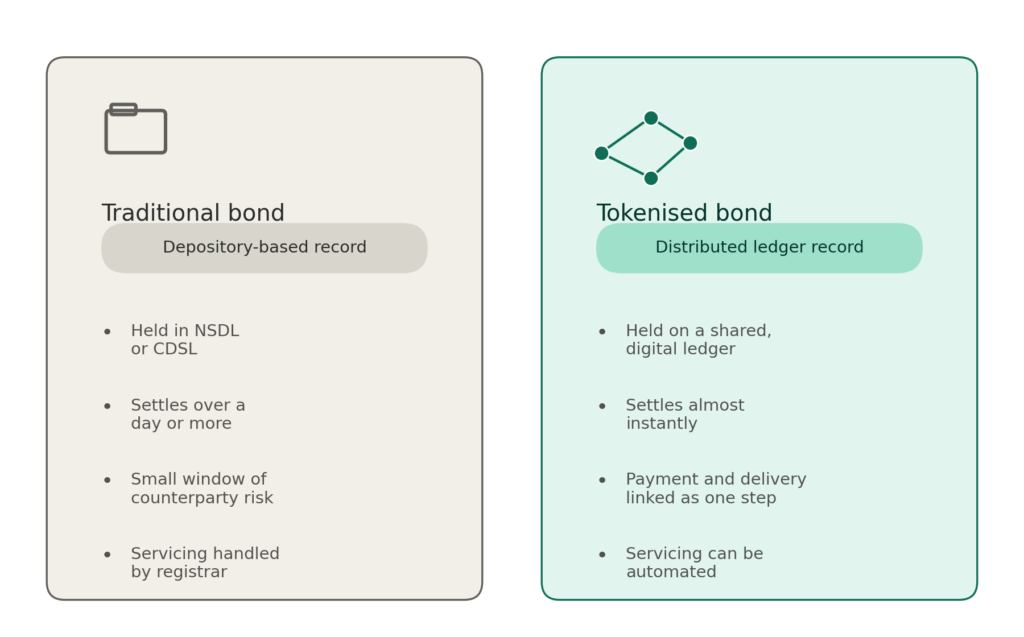
| Metrics | Traditional Bond | Tokenised Bond |
|---|---|---|
| Ownership record | Depository system (NSDL, CDSL) | Distributed ledger |
| Settlement | Multi-step, a day or more | Atomic, near-instant |
| Counterparty risk | A small window of exposure | Reduced, payment and delivery are linked |
| Interest payments | Processed by the issuer or registrar | Can potentially be automated |
| What determines its risk | Issuer, yield, maturity, liquidity | Still the issuer, yield, maturity, liquidity |
India’s Bond Market, Digitised in Stages
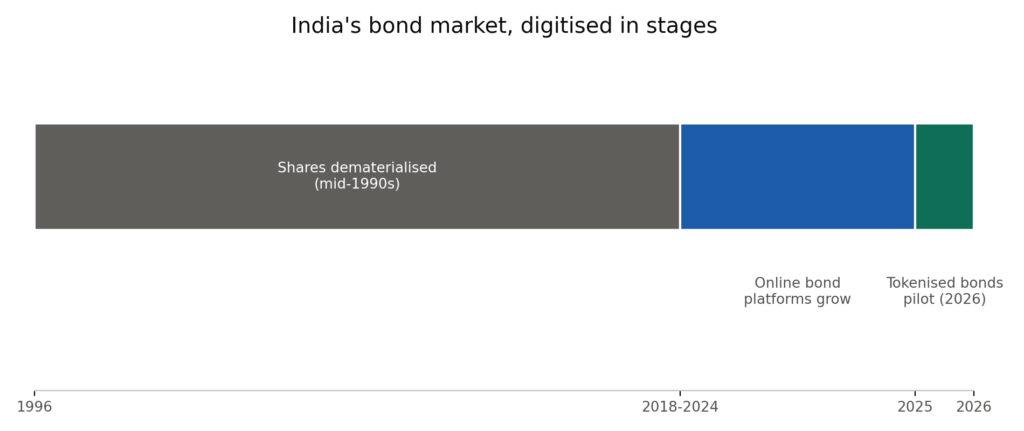
This didn’t happen overnight. Shares moved from paper to dematerialised form in the mid-1990s. Online bond platforms later lowered minimum ticket sizes and opened the debt market to more retail investors. Now, in 2026, tokenisation is the next step, chipping away at the same friction that once kept everyday investors on the sidelines of India’s bond market.
What This Means for You, For Now
- This is still a pilot. Access is currently limited, mostly to institutional and select investors, not yet a mainstream retail option.
- Don’t assume “tokenised” means “guaranteed” or “risk-free.” Keep evaluating any bond the same way you always would.
- Watch this space. If the pilot succeeds, wider retail access and smaller minimum investments could follow, much like online bond platforms already lowered entry barriers in recent years.
- Understand the basic mechanics now, so you’re not starting from zero if tokenised bonds do become part of everyday investing.
Conclusion
For decades, buying a bond in India meant trusting a chain of paperwork and intermediaries moving in the background, mostly out of sight. Tokenisation doesn’t remove the need for trust, but it moves a good part of that trust onto a shared, transparent ledger everyone can check at once.
For investors focused on equities, understanding these developments is useful, but it is equally important to have a disciplined process for identifying and managing stock opportunities. Our positional stock trading advice in India focuses on identifying potential swing setups through technical analysis, stock selection and disciplined risk management.
It’s a change in plumbing, not in promise. The bond still has to be a good bond. It just might, before long, get to you a little faster, and with a little less friction along the way.